
🛡️ No Prepayment
Pay only on arrival
🚗 Door-to-Door Transfer
Directly to the hotel
🏥 Expert Care
English-speaking support
Key Facts
– 3 spa resorts — Rogaška Slatina (digestion), Portorož (Adriatic), Rimske Terme (orthopaedics) – World’s highest magnesium water — Donat-Mg, 1,000 mg/l, Rogaška Slatina – 700-year-old salt pan mud — Fango delle Saline, Portorož, unique worldwide – Roman baths from the 2nd century AD — Rimske Terme, still visible in the spa centre – 2,400 sunshine hours per year — Portorož, frost-free winters, year-round spa – German-speaking doctors and medical staff in all spa hotels – No prepayment — pay at the hotel, book your Slovenia cure without risk
Slovenia at a Glance
| Feature | Details |
|---|---|
| Spas | 3 (Rogaška Slatina, Portorož, Rimske Terme) |
| Healing Factors | Donat-Mg mineral water (Mg 1,000 mg/l), Adriatic salt pan mud, thermal water, seawater |
| Strongest Water | Donat-Mg — world record for magnesium |
| Oldest Spa | Rimske Terme — Roman baths from 2nd century AD |
| Sunniest Spa | Portorož — 2,400 hours/year, subtropical |
| Kurdauer | 7–21 days recommended |
Spa Resorts in Slovenia
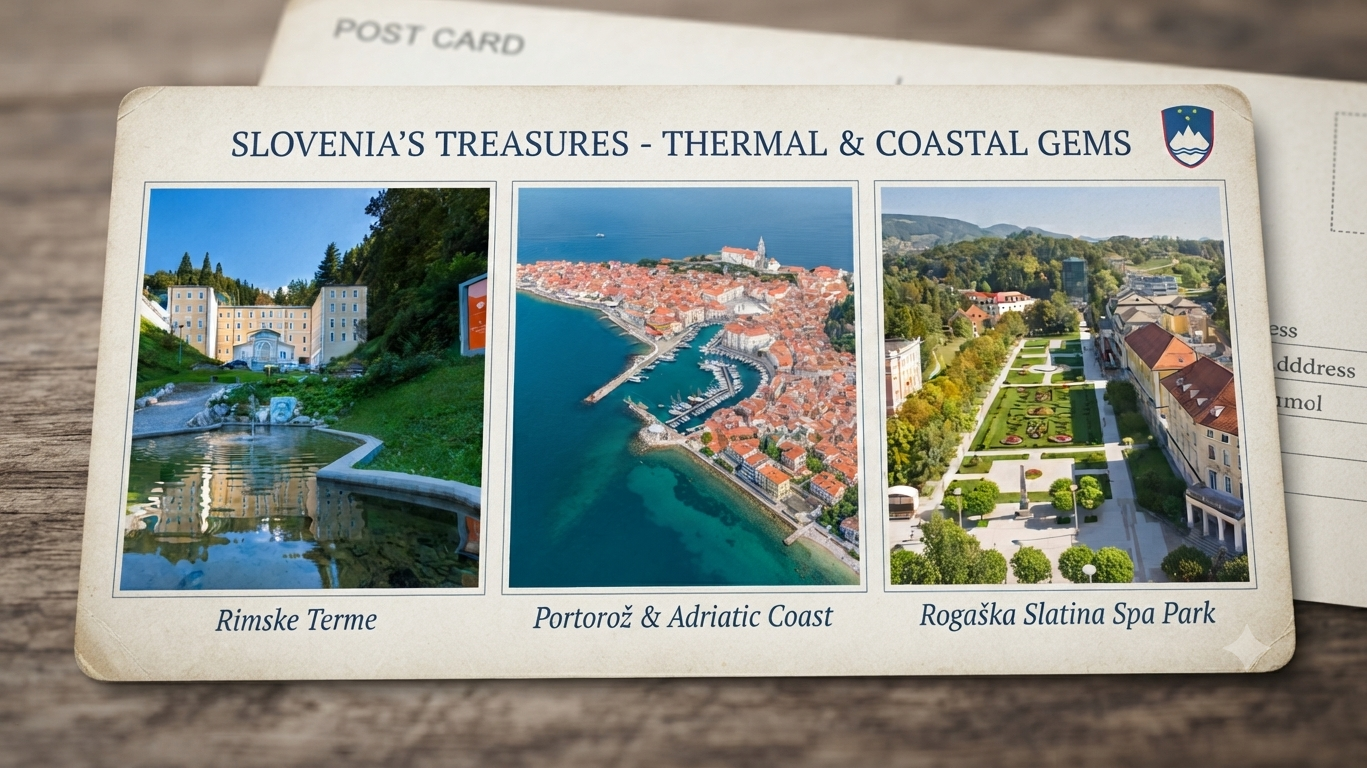
Rogaška Slatina — the world’s leading magnesium spa. The Donat-Mg mineral water, with 1,000 milligrams of magnesium per litre and a total mineralisation of 13 g/l, has no equal anywhere on earth. Magnesium is involved in over 300 enzymatic reactions in the human body — from insulin metabolism to muscle relaxation to cardiac function. Drinking 200–400 ml of Donat-Mg on an empty stomach in the morning has a dual action: locally in the bowel, it draws water osmotically, softening stool and promoting natural elimination without chemical laxatives; systemically, the magnesium is absorbed through the intestinal wall and reaches all organs within 30–60 minutes.
Rogaška Slatina is the best spa for constipation, digestive disorders, diabetes type 2 and magnesium deficiency. The Donat-Mg water is sold in pharmacies across Europe — but the full therapeutic effect unfolds only when drunk fresh at the source. The elegant spa park, the Crystal Hall with daily concerts, the 400-year spa tradition under the Habsburgs, and the surrounding Slovenian wine country make Rogaška Slatina a destination where medical efficacy meets cultural refinement.
Portorož — the Port of Roses on the Slovenian Adriatic. The defining treatment element is the Fango delle Saline: black, mineral-rich mud from the Sečovlje salt pans, matured over 700 years of continuous operation — the oldest working salt pans in the Adriatic. The mud matures in shallow basins where seawater evaporates under the Mediterranean sun, and specific salt-tolerant algae and microorganisms produce organic compounds found nowhere else. Heated to 45–48 °C and applied as a full-body or partial pack for 20 minutes, the fango delivers deep hyperthermia and transdermal absorption of bioactive substances that reduce joint inflammation and improve cartilage metabolism. A course of 12–15 packs is prescribed for arthrosis and rheumatism.
The subtropical climate — 2,400 sunshine hours per year, frost-free winters, summer temperatures moderated by the sea breeze — makes Portorož a year-round Adriatic spa. The salt pans themselves are a nature park where you can walk through the basins. The medieval town of Piran, 3 kilometres away, is one of the most beautiful Venetian coastal towns on the Adriatic. Portorož is the best spa for musculoskeletal treatment with a Mediterranean climate — a warmer, sunnier counterpart to the Baltic spas.
Rimske Terme — the roman baths. The thermal water at 38–42 °C emerges in the Savinja River valley at the exact spot where Roman legionaries built a bathing complex in the 2nd century AD. The excavated pools, hypocaust heating system and stone walls are visible inside the modern spa centre — you walk through the treatment area and see where Romans bathed 2,000 years ago. The water is calcium-magnesium-hydrogen-carbonate with a very low mineralisation of 0.5 g/l — which makes it exceptionally gentle on the skin and safe for patients with hypertension, heart conditions or sensitive skin who cannot bathe in highly mineralised waters.
Rimske Terme is a compact medical spa with three hotels focused on post-operative orthopaedic rehabilitation — after joint replacement, fracture, or spinal surgery — and chronic back pain. The physiotherapy programme uses the thermal water’s buoyancy for pain-free mobilisation. electrotherapy, magnetotherapy and lymphatic drainage complete the treatment plan. This is not a resort for sightseeing or gastronomy — it is a focused medical facility for regaining mobility, quiet and without distractions.
Spa Resorts Compared
| Spa | Healing Factor | Speciality |
|---|---|---|
| Rogaška Slatina ★★★ | Donat-Mg 1,000 mg/l Mg, 13 g/l total | Digestion ★★★, Constipation, Diabetes, Magnesium Deficiency |
| Portorož ★★★ | Adriatic climate, Fango delle Saline, thermal water 37 °C | Musculoskeletal ★★★, Dermatology ★★★, Respiratory |
| Rimske Terme ★★ | Thermal water 38–42 °C, Ca-Mg-HCO₃, 0.5 g/l | Orthopaedics ★★, Post-Surgery Rehab, Geriatric |
Treatments in Slovenia
Donat-Mg drinking cure: The cornerstone of Rogaška Slatina. 200–400 ml of Donat-Mg water, drunk on an empty stomach in the morning. The magnesium concentration of 1,000 mg/l — 300 ml covers the entire daily requirement — triggers an osmotic water shift into the bowel, producing a natural laxative effect within 30–120 minutes, without cramps. Simultaneously, magnesium is absorbed systemically, improving insulin sensitivity, muscle relaxation and cardiac function. A three-week course establishes a digestive rhythm that many patients maintain afterward by drinking Donat-Mg at home. Drinking cure treatment — learn more.
Fango delle Saline mud pack: The 700-year-old salt pan mud at Portorož is applied at 45–48 °C as a full-body or partial pack for 15–20 minutes, followed by 20 minutes of passive sweating. The bioactive compounds penetrate transdermally and inhibit inflammatory enzymes in joint capsules. Twelve to fifteen packs over three weeks is the standard course. Moor pack treatment — learn more.
Thermal bath at Rimske Terme: The low-mineralisation water at 38–42 °C is used for 15–20 minute full baths. Because the mineral content is only 0.5 g/l, the water does not stress the cardiovascular system — patients with hypertension bathe here safely. The warmth relaxes muscles without the circulatory burden of highly mineralised waters. After the bath, physiotherapists perform passive and active mobilisation that would be painful without the preceding thermal relaxation.
Adriatic thalassotherapy at Portorož: Sea-water baths, algae packs, and aerosol inhalation along the coast complement the fango therapy. The Adriatic water at 24–26 °C in summer allows prolonged swimming and movement — a natural, joint-sparing exercise therapy under the Mediterranean sun.
History and Spa Tradition
Rogaška Slatina has been known since Roman times — coin finds attest to bathing activity 2,000 years ago. The systematic spa operation began in the 16th century and reached its zenith in the 19th century under the Habsburgs. Emperor Franz Joseph I was a regular guest. The Donat-Mg spring, named after the Church of St. Donatus on a hill above the town, rises from dolomite rock layers at 280–600 metres depth — the magnesium enrichment is a geological gift unique to this location.
Portorož was established by Benedictine monks in the 13th century, who founded the Monastery of San Lorenzo and the first salt pans. The monks recognised the therapeutic properties of the salt pan mud and treated joint diseases with it — a tradition unbroken for 700 years. The Sečovlje salt pans are now a protected nature park and a living museum of salt production. Piran, the Venetian coastal gem 3 kilometres away, was home to the violinist and composer Giuseppe Tartini.
Rimske Terme is almost literally a spa where history is the floor you walk on. The Roman bathing complex from the 2nd century AD — excavated pools, heating channels, stone walls — is integrated into the modern spa centre. The Romans called the settlement Aquae Celeiae, after the nearby Roman city of Celeia (now Celje). Continuous bathing use for 2,000 years makes Rimske Terme one of the oldest continuously operating spa sites in Europe.
Typical Spa Day in Slovenia (Rogaška Slatina)
| Time | Activity |
|---|---|
| 07:00 | Rise — drinking cure with Donat-Mg, 300 ml |
| 07:30 | Rest period — 20 minutes, gentle movement |
| 08:00 | Breakfast |
| 09:00 | Mineral bath — 20 minutes |
| 10:00 | Walk in the spa park — 45 minutes |
| 11:00 | Physiotherapy or dietary consultation |
| 12:30 | Lunch |
| 14:00 | Massage or lymphatic drainage |
| 16:00 | Second drinking cure — 200 ml |
| 17:30 | Dinner |
| 19:00 | Evening walk — Crystal Hall or vineyard hills |
Frequently Asked Questions
Is Donat-Mg better than magnesium tablets?
Yes — the magnesium in Donat-Mg is dissolved as Mg²⁺ ions and absorbed more efficiently through the intestinal wall than magnesium from tablets. The water also contains hydrogen carbonate and sulfate that support digestion — a tablet provides only the magnesium. Drinking 300 ml of Donat-Mg covers the entire daily magnesium requirement while simultaneously treating constipation.
Can I drink Donat-Mg at home after the cure?
Yes — it is sold in pharmacies across Europe. However, the full therapeutic effect unfolds only at the source, where the water is fresh and the cure is combined with mineral baths, dietary consultation and the structured daily rhythm of the spa. Drinking Donat-Mg at home is an excellent maintenance therapy between spa stays.
Is Portorož too touristy for a medical spa?
The beach promenade can be lively in July and August, but the spa district with its fango centre, thermal baths and spa hotels is separate from the tourist beach area. The peak season for medical treatment is spring and autumn, when the climate is ideal and the resort is quieter. Winter is mild and frost-free — a year-round Adriatic spa that the Baltic resorts cannot offer.
How is Rimske Terme different from other orthopaedic spas?
The extremely low mineralisation of 0.5 g/l makes the water safe for patients who cannot use the highly mineralised waters of Piešťany or Abano Terme. The spa’s small size — three hotels — guarantees personal, individualised care. And bathing in the same location where Romans bathed 2,000 years ago has a psychological dimension that no modern spa building can replicate. Compare Slovenian spas — see all comparisons.
Note: This information is for general guidance only and does not replace individual medical advice or diagnosis by a physician.

Author: Kuropa Editorial Team
Expert review: Anastasia Folak, Head of Spa Advisory
15+ years of experience in spa travel consulting
More about our expertise →