
🛡️ No Prepayment
Pay only on arrival
🚗 Door-to-Door Transfer
Directly to the hotel
🏥 Expert Care
English-speaking support
Key Facts
– The foundation of every spa cure — physiotherapy translates passive treatments into active recovery – Thermal water amplifies effectiveness — buoyancy reduces body weight by 90 percent, enabling pain-free movement – 6 specialised spa resorts — Hévíz ★★★, Piešťany ★★★, Karlovy Vary ★★, Budapest ★★, Abano Terme ★★, Druskininkai ★★ – Underwater traction — invented in Hévíz in 1953, the gentlest spinal decompression in European balneology – Mirror Pool biofeedback — real-time underwater video correction of posture and gait, unique to Piešťany – German-speaking physiotherapists at all recommended spas – No prepayment — pay at the hotel on arrival
Physiotherapy at a Glance
| Feature | Details |
|---|---|
| Definition | Medically guided restoration of movement and function using exercise, manual therapy and specialised techniques |
| Key Spas | 6: Hévíz, Piešťany, Karlovy Vary, Budapest, Abano Terme, Druskininkai |
| Special Techniques | Underwater traction (Hévíz), Mirror Pool biofeedback (Piešťany), hydrokinesitherapy (Abano Terme) |
| Duration per Session | 20–45 minutes, once or twice daily |
| Frequency | Daily or every second day, as prescribed |
| Kurdauer | 14–21 days recommended |
What Is Physiotherapy in a Spa Context?
Spa physiotherapy differs from conventional clinic-based physiotherapy in one critical aspect: it is performed in the medium that makes movement easiest — warm water. The buoyancy of thermal water at 34–38 °C reduces the patient’s effective body weight to about one-tenth of normal. A movement that is painful or impossible on land — lifting an arm after shoulder surgery, bending a knee after joint replacement, twisting the spine with a herniated disc — becomes pain-free in water. The warmth relaxes the muscles that would otherwise guard against movement, eliminating the protective spasm that physiotherapists on land must work against.
This water-based advantage is amplified by spa-specific techniques:
underwater traction (Hévíz) — the patient is suspended vertically in 38 °C thermal water and stretched by body weight. The heat eliminates all muscle guarding; the spine decompresses without resistance. No pharmaceutical muscle relaxant can produce this degree of relaxation. Three sessions per week, 20 minutes each. This is the most effective non-surgical treatment for herniated discs and chronic back pain in European balneology.
Mirror Pool training (piešťany) — a pool with a mirrored bottom and underwater cameras films the patient’s movements and displays them in real time on a monitor. The patient sees their own gait and posture — often for the first time seeing the asymmetries and compensations that years of pain have made unconscious. Biofeedback-guided correction is several times more effective than verbal instruction alone.
Hydrokinesitherapy (Abano Terme) — rehabilitation exercises in thermal pools under physiotherapist supervision. The 87 °C source water is cooled to 34–38 °C for exercise. The heat from the preceding fango pack has already relaxed the deep musculature; the physiotherapist uses this therapeutic window for maximum joint mobilisation.
Classical physiotherapy (all spas) — manual mobilisation, therapeutic exercise, gait training, postural correction, balance exercises, and muscle strengthening. At Druskininkai, physiotherapy is integrated into the multidisciplinary treatment of up to eight conditions simultaneously.
Which Spas Offer Specialised Physiotherapy?
| Spa | Country | Special Technique | Best For | ★ |
|---|---|---|---|---|
| Hévíz | Hungary | Underwater traction in thermal lake | Herniated disc, chronic back pain, Bechterew’s disease | ★★★ |
| Piešťany | Slovakia | Mirror Pool biofeedback, underwater traction | Post-joint replacement, gait correction, arthrosis | ★★★ |
| Abano Terme | Italy | Hydrokinesitherapy after fango | Post-operative mobilisation, deep joint work | ★★ |
| Karlovy Vary | Czech Republic | Classical physiotherapy + Parafango preparation | Arthrosis, post-operative, general rehabilitation | ★★ |
| Budapest | Hungary | Thermal pool physiotherapy | General rehabilitation, arthrosis, post-surgery | ★★ |
| Druskininkai | Lithuania | Multidisciplinary physiotherapy — 8 categories | Multiple simultaneous conditions | ★★ |
Who Can Benefit from Physiotherapy?
| Condition | Recommended Spa | Mechanism |
|---|---|---|
| Herniated Disc | Hévíz, Piešťany | Underwater traction decompresses discs without muscle guarding |
| Post-Joint Replacement | Piešťany, Abano Terme | Water-based mobilisation weeks earlier than land-based — pain-free |
| Chronic Back Pain | Hévíz, Piešťany | Underwater traction + heat — maximum muscle relaxation |
| Arthrosis | Karlovy Vary, Budapest | Water buoyancy unloads joints, enabling mobilisation |
| Post-Stroke | Druskininkai | Multidisciplinary — physiotherapy integrated with neurology programme |
| Bechterew’s Disease | Hévíz, Piešťany | Underwater traction + warmth maintain spinal mobility |
| Sports Injuries | Abano Terme | Hydrokinesitherapy after fango — deep heat enables deep mobilisation |
Not suitable for: acute injuries with instability, open wounds, acute infections, and severe cardiovascular insufficiency. The spa doctor and physiotherapist determine individual suitability.
How Physiotherapy Works Step by Step
Before the first session, the spa doctor conducts an examination and prescribes the type, frequency and intensity of physiotherapy. Bring current medical reports, imaging results, and a description of your movement limitations. The physiotherapist assesses your current range of motion, strength and gait.
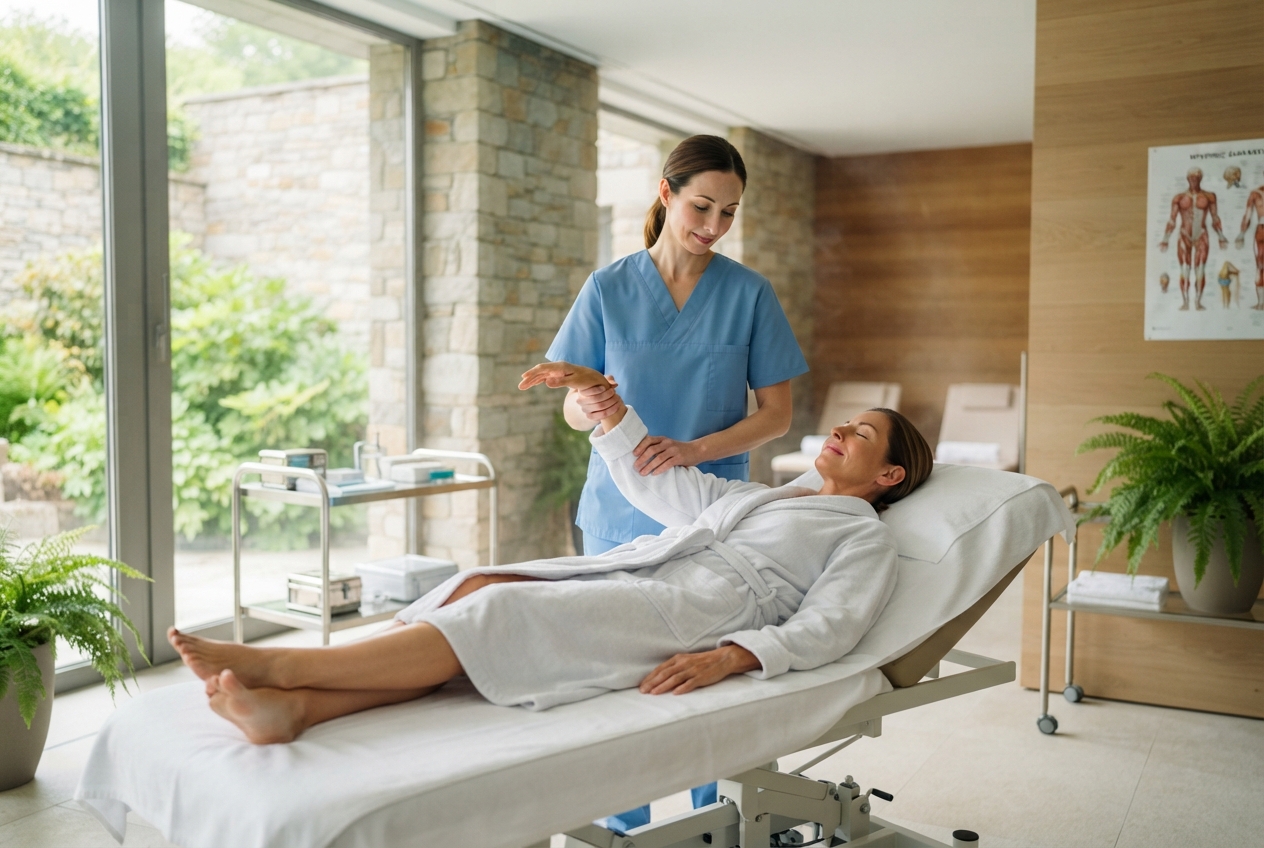
A typical session lasts 20–45 minutes in warm thermal water or on land. The physiotherapist guides you through movements — passive mobilisation where they move the joint for you, active-assisted where you move with support, and active where you move independently. In the Mirror Pool, you watch your own movements on the monitor and correct them in real time. In underwater traction, you are suspended and the water does the work.
The progression over two to three weeks is measurable. Week one: pain reduction and initial mobilisation. Week two: increased range of motion and muscle activation. Week three: functional training — walking, stair climbing, daily activities — with the corrected movement patterns now becoming automatic. Underwater traction — learn more about the full programme.
What to bring: swimwear for water-based sessions, comfortable clothing and supportive shoes for land-based sessions. The spa provides all equipment. Your physiotherapist will advise you on any specific items.
A Typical Spa Day with Physiotherapy
| Time | Activity |
|---|---|
| 07:00 | Rise — light self-stretching |
| 07:30 | Drinking cure or morning walk |
| 08:00 | Breakfast |
| 09:00 | Thermal bath or moor pack — preparation for physiotherapy |
| 10:00 | Physiotherapy session — 30–45 minutes in water or on land |
| 11:00 | Rest period — the body integrates the movement work |
| 12:30 | Lunch |
| 14:00 | Massage or second, lighter physiotherapy session |
| 15:30 | Walk in the spa park — practising corrected gait |
| 17:30 | Dinner |
| 19:00 | Evening walk — gentle, restorative |
Frequently Asked Questions
Can physiotherapy in a spa replace my physiotherapy at home?
It complements it — and often achieves in three weeks what months of weekly sessions cannot. The daily frequency (as opposed to once or twice a week at home), the water-based environment, and the integration with thermal baths and moor packs create a therapeutic intensity that outpatient physiotherapy cannot match. The goal is to make enough progress during the spa course that subsequent home physiotherapy becomes more effective.
Is underwater traction painful?
No — it is the gentlest form of spinal decompression. The 38 °C water eliminates all muscle guarding, so the stretch is applied to a completely relaxed spine. Most patients find the sensation pleasant — a feeling of lengthening and release. Any discomfort during land-based traction (muscle spasm, guarding) is absent.
How soon after joint replacement can I start spa physiotherapy?
Typically 6–12 weeks after surgery, following clearance from your orthopaedic surgeon. The water-based environment allows mobilisation earlier than land-based physiotherapy because there is no weight-bearing on the new joint. Piešťany and Abano Terme specialise in post-arthroplasty rehabilitation.
Will I be sore after physiotherapy?
Some muscle soreness is normal — your body is relearning movement patterns it has avoided for months or years. The thermal bath or moor pack on the following day relieves this soreness. The spa programme is designed so that treatments support each other: the passive morning treatments prepare for the active physiotherapy, and the rest periods allow recovery. Compare European spas — see all comparisons.
Note: This information is for general guidance only and does not replace individual medical advice or diagnosis by a physician.

Author: Kuropa Editorial Team
Expert review: Anastasia Folak, Head of Spa Advisory
15+ years of experience in spa travel consulting
More about our expertise →