
🛡️ No Prepayment
Pay only on arrival
🚗 Door-to-Door Transfer
Directly to the hotel
🏥 Expert Care
English-speaking support
Key Facts
• Luga mud ★★★ — 350 g/l minerals, 295 g/l magnesium, world record, higher than the Dead Sea
• 12 hyperthermal springs — 38–46 °C, low-mineralisation hydrocarbonate water
• Roman baths — 2nd century AD, 7,000 m², largest on the Balkan Peninsula
• 2,300 sunshine hours/year — dry climate (500 mm rain), mild winters, frost-free
• Specialisation ★★★ — musculoskeletal, respiratory, dermatology, neurology
• German-speaking doctors at international spa hotels
• No prepayment — pay at the hotel on arrival
Varna at a Glance
| Feature | Details |
|---|---|
| History | 2nd century AD — Roman baths, modern spa since the 20th century |
| Springs | 12 hyperthermal springs, 38–46 °C, hydrocarbonate, 553–592 mg/l |
| Luga Mud | From Varna Lake — 350 g/l minerals, 295 g/l Mg ★★★ |
| Specialisation | Musculoskeletal ★★★, Respiratory ★★★, Dermatology ★★, Neurology ★★ |
| Climate | Black Sea, 2,300 sunshine hours, dry (500 mm/year), mild winters |
| Kurdauer | 14–21 days recommended |
What Does Varna Treat?
varna is a universal Black Sea spa resort with the broad spectrum of the Black Sea coast, specialised on the musculoskeletal system and respiratory tract.
– Arthrosis, rheumatism — luga packs and thermal baths (★★★) – Chronic bronchitis, asthma — Black Sea climate, dry and mild (★★★) – COPD — saline sea air and inhalation – Psoriasis — luga packs, sun and seawater – Post-joint replacement — warm climate, thermal water-based exercise – Neurological conditions — post-stroke, polyneuropathy – Gynaecological conditions — luga packs – cardiovascular diseases — mild climate, exercise
The Healing Factors of Varna
| Factor | Property | Effect |
|---|---|---|
| Luga Mud ★★★ | From Varna Lake, 350 g/l, 295 g/l Mg | World’s highest magnesium concentration — muscle relaxation, anti-inflammatory |
| Thermal Water | 38–46 °C, hydrocarbonate, 553–592 mg/l | Gentle mineralisation, cardiovascular-safe |
| Black Sea Climate | 2,300 sunshine hours, dry (500 mm/year), mild winters | Year-round use, pollen-poor |
| Seawater | Black Sea, 24–26 °C in summer | Intense sunshine, 17 ‰ salinity (lower than the Mediterranean) |
Treatments in Varna
Luga therapy: The unique Varna treatment. The black, oily mud from Varna Lake is applied as a full-body or partial pack. Unlike the mineral sulfur mud of Piešťany or the volcanic fango of Abano Terme, the luga is a hypersaline organic mud — formed from salt-tolerant bacteria and algae that have died over millennia in the lake’s extreme saline environment, creating a unique organic matrix of bioactive compounds. The magnesium concentration of 295 g/l — a world record — relaxes musculature and inhibits inflammatory enzymes. The pack is heated to 40–42 °C and applied for 20 minutes. A course of 12–15 packs is standard. Moor pack treatment — learn more.
Salt grotto: A room with walls built from luga minerals, where a generator disperses fine salt particles into the air. The patient spends 30–45 minutes in the grotto — the dry, salt-saturated air reaches deep into the bronchial tree, liquefying mucus and opening constricted airways. One of the most effective natural treatments for chronic bronchitis, asthma and COPD in our network.
Thermal Bath: The low-mineralisation hydrocarbonate water at 38–42 °C is used in thermal pools. The low mineral content makes the water particularly skin-friendly and safe for cardiovascular patients.
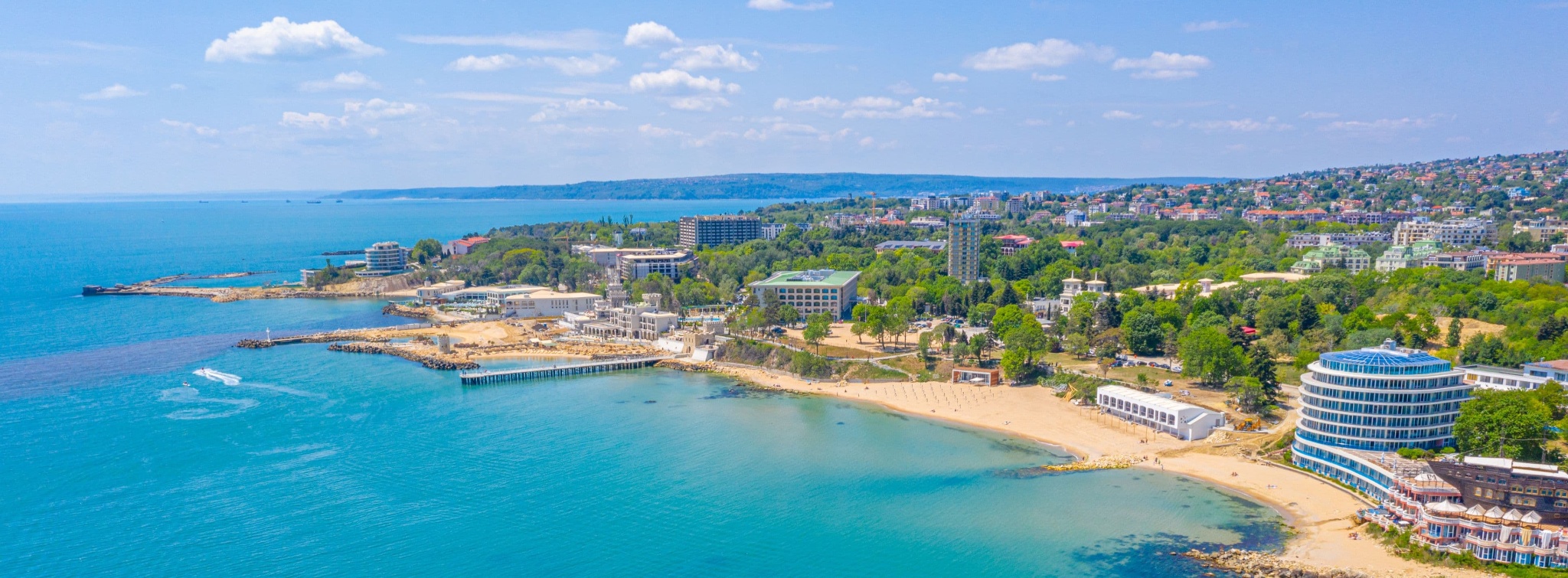
Black Sea bathing: The Black Sea, with a salinity of 17 parts per thousand — roughly half that of the Mediterranean — is gentler on skin and eyes. Summer water temperatures of 24–26 °C allow prolonged swimming, which serves as natural, joint-sparing exercise therapy under the intense Black Sea sunshine.
History and Atmosphere
Varna has one of the longest bathing histories in Europe. The roman baths from the 2nd century AD — 7,000 square metres, the largest on the Balkan Peninsula — are preserved in the city centre. They testify to ancient Odessos, as Varna was then called, being a major spa destination in antiquity. The baths featured numerous rooms for bathing, relaxation and socialising — a concept 2,000 years ahead of modern spa design.
The luga therapy is a 20th-century development. Varna Lake, a coastal lagoon separated from the Black Sea by a sand bar, was analysed in the mid-20th century by Bulgarian balneologists who discovered its extraordinary mineral concentration — magnesium at 295 g/l, comfortably the highest of any therapeutic product worldwide. The discovery placed Varna on the map of international medical balneology.
Varna itself is a layered city. The Archaeological Museum holds the Varna Gold Treasure — the oldest worked gold in human history, dating to 4,500 BC, predating both Egyptian pyramids and Mesopotamian civilisation. The Dormition of the Mother of God Cathedral, the Sea Garden park running along the coast, and the dolphinarium complete a cultural landscape that makes Varna more than just a medical spa resort.
Attractions Near Varna
– 🏛 Roman Baths — 2nd century AD, 7,000 m², one of the largest on the Balkan Peninsula – 🏺 Archaeological Museum — Varna Gold Treasure, oldest worked gold in the world (4,500 BC) – ⛪ Dormition Cathedral — largest Orthodox church in the city, impressive frescoes – 🌊 Beach Promenade — kilometres of sandy beach with cafés and sea views – 🌿 Sea Garden — the city’s largest park, directly on the coast, with dolphinarium
Getting to Varna from Germany
Varna lies on the Bulgarian Black Sea coast and is the easternmost spa resort in our programme. Access is by flight to Varna International Airport — direct connections from several German cities, flight time approximately 2 hours 30 minutes, transfer to the spa hotel 15 minutes. The door-to-door transfer by road — approximately 1,800 kilometres from Munich — is not practical without a multi-day journey.
A Typical Spa Day in Varna
| Time | Activity |
|---|---|
| 07:30 | Rise — walk on the Black Sea beach |
| 08:00 | Breakfast |
| 09:00 | Luga mud pack — 20 minutes at 40–42 °C |
| 09:30 | Rest period — 20 minutes |
| 10:00 | Thermal bath — 20 minutes |
| 11:00 | Physiotherapy or movement therapy |
| 12:30 | Lunch |
| 14:00 | Salt grotto — 45 minutes |
| 15:00 | Black Sea bathing or massage |
| 16:30 | Walk in the Sea Garden |
| 17:30 | Dinner |
| 19:00 | Evening walk — beach promenade |
Frequently Asked Questions
Is the luga really better than Dead Sea mud?
The luga from Varna Lake has a higher total mineral concentration (350 g/l vs. approximately 300 g/l for the Dead Sea) and a dramatically higher magnesium concentration (295 g/l — a world record). But the key difference is the organic matrix: Varna Lake mud contains bioactive compounds from salt-tolerant bacteria and algae evolved over millennia — substances absent from the purely mineral Dead Sea mud.
Is the long journey to Bulgaria worthwhile?
For patients with chronic arthrosis, rheumatism or respiratory diseases who have not achieved sufficient relief from Central European spas, Varna offers a healing factor — the luga mud with 295 g/l magnesium — that exists nowhere else. Direct flights from Germany take about 2 hours 30 minutes. The lower costs in Bulgaria make Varna the most affordable European spa destination in our programme.
Can Varna be used year-round?
Yes — the dry climate with mild winters (rarely below 0 °C) and 2,300 annual sunshine hours makes Varna a true year-round Black Sea spa. The pollen-poor winter air is particularly beneficial for respiratory patients.
Are there German-speaking doctors?
At the international spa hotels serving German and Austrian guests, doctors speak English and some German. The German-speaking care is developing as the resort attracts more patients from German-speaking countries. Compare Bulgarian spas — see all comparisons.
Note: This information is for general guidance only and does not replace individual medical advice or diagnosis by a physician.

Author: Kuropa Editorial Team
Expert review: Anastasia Folak, Head of Spa Advisory
15+ years of experience in spa travel consulting
More about our expertise →