
🛡️ No Prepayment
Pay only on arrival
🚗 Door-to-Door Transfer
Directly to the hotel
🏥 Expert Care
English-speaking support
Key Facts
• World leader in musculoskeletal treatment ★★★ — over 200 years of specialisation
• Europe’s hottest therapeutic water — 67–69 °C from 2,000 m depth
• Sulfur mud museum — from the Váh River, prepared with 100 % thermal water at 39 °C
• Mirror Pool biofeedback — real-time underwater video correction of movement patterns
• Crutch Breaker statue — world-famous symbol since 1933
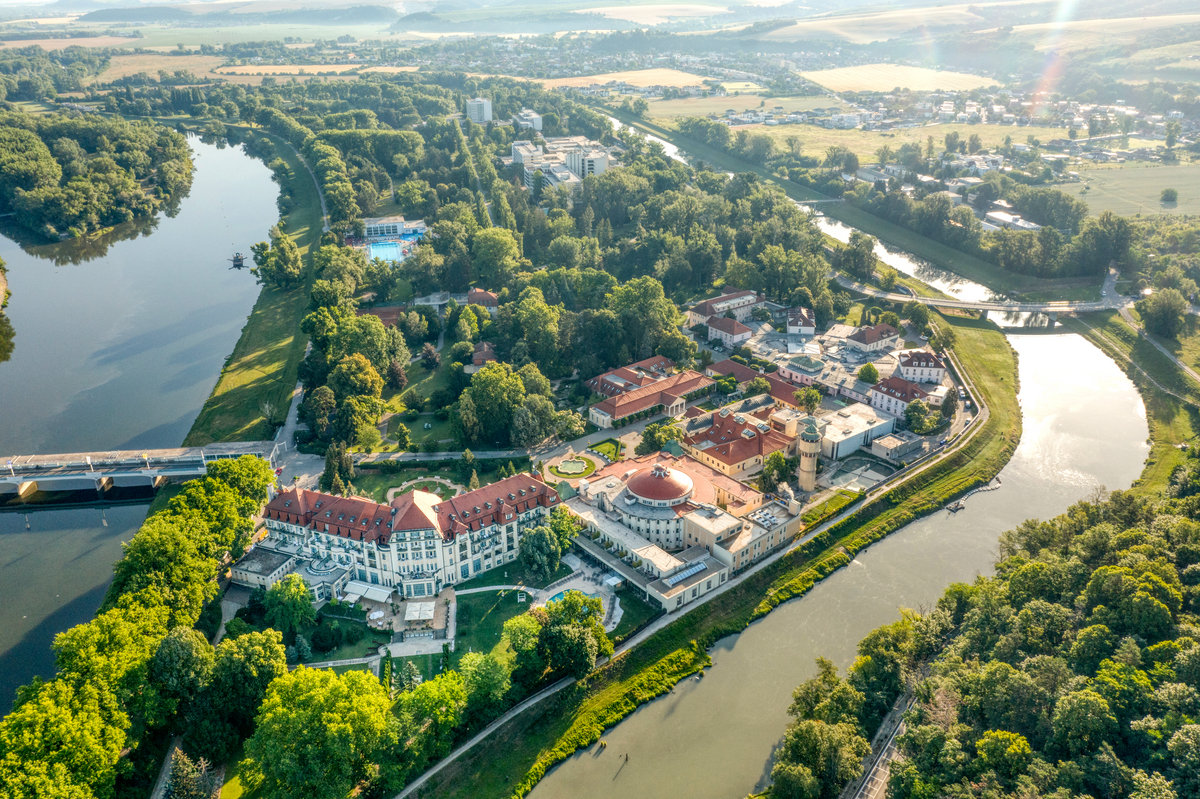
• Spa Island — 68 hectares, 9 spa hotels, covered colonnades, no cars
• German-speaking doctors and therapists in all spa hotels
• No prepayment — pay at the hotel on arrival
Piešťany at a Glance
| Feature | Details |
|---|---|
| Thermal Water | 67–69 °C, sulfate-hydrogen-carbonate, from 2,000 m depth |
| Sulfur Mud | From Váh River bed, prepared with 100 % thermal water at 39 °C |
| Spa Island | 68 hectares, 9 spa hotels, covered colonnades |
| Signature Symbol | Crutch Breaker (Barlolámač) — bronze statue from 1933 |
| Specialisation | Musculoskeletal ★★★, Rheumatology ★★★, Arthrosis, Rehabilitation |
| Innovation | Mirror Pool — underwater biofeedback training |
| Kurdauer | 14–21 days (18–24 mud baths recommended) |
What Does Piešťany Treat?
piešťany is the specialist for all musculoskeletal conditions — from arthrosis to post-joint-replacement rehabilitation. The high temperature of the sulfur water and the deep-penetrating effect of the mud reach joint capsules and cartilage tissue that other spas cannot access.
– Arthrosis — sulfur mud regenerates cartilage, warmth relieves pain (★★★) – Rheumatoid arthritis — in remission phases, hydrogen sulfide inhibits inflammatory enzymes (★★★) – Bechterew’s disease — warmth and underwater traction improve spinal mobility (★★★) – Chronic back pain — deep heat reaches the intervertebral disc region – Herniated disc — underwater traction and heat therapy – Post-joint replacement — Mirror Pool training, gait school, muscle strengthening – Gout — sulfur promotes uric acid excretion – osteoporosis — movement in warm water, fall prevention
The Healing Factors of Piešťany
| Factor | Property | Effect |
|---|---|---|
| Thermal Water | 67–69 °C, sulfate-hydrogen-carbonate, 2,000 m depth | Strongest heat transfer, deep muscle relaxation |
| Sulfur Mud | From Váh River, 100 % thermal water preparation, 39 °C | Hydrogen sulfide inhibits cartilage-degrading enzymes |
| Mirror Pool | Pool with mirrored bottom and underwater cameras | Real-time video feedback corrects movement patterns |
| Underwater Traction | 38 °C thermal pool | Spinal decompression in maximum muscle relaxation |
Treatments in Piešťany
Sulfur mud bath: The core treatment. The Váh River mud — black, mineral-rich, sulfur-saturated — is heated to precisely 39 °C with 100 percent thermal water, never tap water. At this temperature, hydrogen sulfide release peaks. The patient lies in a tub filled with warm mud for 15 minutes. The mud is then rinsed off with thermal water, and the patient is wrapped in thermal foil for 20 minutes of passive sweating — the hydrogen sulfide concentration in the skin reaches its maximum during this phase. A full course comprises 18 to 24 mud baths over three weeks, and the anti-inflammatory effect lasts for months after the course. moor pack treatment — learn more.
Mirror Pool training: A Piešťany innovation. The pool has a mirrored bottom and underwater cameras that film the patient’s movements and display them in real time on a monitor. The patient sees their own posture and gait and can correct misalignments immediately — biofeedback-guided physiotherapy that is several times more effective than conventional exercise therapy. Years of pain-compensated movement patterns are unlearned and replaced with correct biomechanics.
Thermal bath: The 67–69 °C water is cooled to a therapeutic 38 °C and used as a full bath — 15–20 minutes. The heat prepares the musculature for the subsequent exercise therapy. The sulfur and minerals are absorbed transdermally during the bath.
Underwater traction: The spine is gently stretched in 38 °C thermal water using body weight. The heat eliminates muscle counter-reflexes — the intervertebral discs decompress in complete relaxation. This is the most effective non-surgical treatment for herniated disc available in any European spa.
History and Atmosphere
The warm springs on the Váh River were known as early as the 16th century, but Piešťany’s rise to international prominence began around 1900 when the Winter family — Hungarian aristocrats — purchased the island and systematically developed it into a medical spa. They commissioned the still-standing Art Nouveau spa hotels, the covered colonnades connecting all nine hotels, and the spa park planted with rare trees from around the world. The Thermia Palace, opened in 1912, is the flagship — an Art Nouveau masterpiece that remains one of the most beautiful spa hotels in Europe.
The Crutch Breaker statue was commissioned by the Winter family in 1933. The bronze figure of a man breaking his crutch over his knee is not merely a symbol — patients from across Europe arrive on the island with walking aids and leave without them. The statue captures the core promise of Piešťany: this is where the body learns to move again.
During the Cold War, Piešťany served as the rehabilitation centre for the Soviet elite — cosmonauts, generals, and Politburo members recovered here. The spa infrastructure from that era was modern for its time and has been continuously upgraded.
Today, Piešťany is a modern spa town with a historic core. The island — 68 hectares of greenery in the middle of the river — is a self-contained world: no cars, no city noise, only the nine spa hotels, the colonnades, the park, and the sound of the Váh. The atmosphere is medically focused but relaxed — patients in bathrobes on their way to the next treatment define the scene.
Attractions Near Piešťany
– 🗿 Crutch Breaker (Barlolámač) — world-famous bronze statue from 1933, symbol of the spa – 🌉 Colonnade Bridge — covered glass bridge over the Váh, 156 m, connects island to town – 🏛 Thermia Palace — magnificent Art Nouveau spa hotel from 1912, the island’s flagship – 🌿 Spa Park — 68 hectares with rare trees, walking paths and monuments – 🎵 Music Pavilion — daily spa concerts in summer – ⛲ Mirror Pool — the biofeedback training pool, architecturally impressive
Getting to Piešťany from Germany
Piešťany lies in western Slovakia. From Nuremberg it is 600 kilometres (5 hours 30 minutes), from Munich 680 kilometres (6 hours), from Vienna only 160 kilometres (1 hour 45 minutes). The door-to-door transfer with German-speaking driver brings you directly to the island. Piešťany has its own railway station with connections from Bratislava. Bratislava Airport (70 km) and Vienna Airport (160 km) are alternatives.
A Typical Spa Day in Piešťany
| Time | Activity |
|---|---|
| 06:30 | Rise — light stretching to activate the joints |
| 07:00 | Morning walk on Spa Island — activates the joints |
| 08:00 | Breakfast |
| 09:00 | Sulfur mud bath — 15 minutes at 39 °C |
| 09:30 | Passive sweating in thermal foil — 20 minutes |
| 10:00 | Rinse with thermal water |
| 10:30 | Rest period |
| 11:00 | Mirror Pool training or physiotherapy |
| 12:30 | Lunch |
| 14:00 | Thermal bath — 20 minutes |
| 15:00 | Massage or lymphatic drainage |
| 16:30 | Walk across the Colonnade Bridge |
| 17:30 | Dinner |
| 19:00 | Evening walk on Spa Island |
Frequently Asked Questions
Why is the Váh River mud so special?
The Váh mud is a mineral-rich sediment deposited over millennia in the riverbed. It contains a unique combination of sulfur compounds, organic acids and trace elements. The preparation with 100 percent thermal water — not tap water — and the precise heating to 39 °C for maximum hydrogen sulfide release is unique worldwide in this precision. The deep heat penetrates 5–8 centimetres into the tissue — deeper than any water bath.
How many mud baths do I need?
The spa doctors recommend 18 to 24 mud baths per three-week course. The first three to five baths are an adaptation phase — the full therapeutic effect develops from the second week onward. The anti-inflammatory effect of the final baths lasts for months after the course.
What is the difference between Piešťany and Hévíz?
Hévíz offers the unique nature experience of a thermal lake and a gentler therapy. Piešťany delivers the most intensive sulfur mud therapy with the hottest water in Europe — stronger, more clinical, for severe musculoskeletal cases. For arthrosis and rheumatology where maximum anti-inflammatory intensity is needed, Piešťany is the stronger address. For a nature-immersed, gentler approach, Hévíz is preferable. Compare European spas — see all comparisons.
Note: This information is for general guidance only and does not replace individual medical advice or diagnosis by a physician.

Author: Kuropa Editorial Team
Expert review: Anastasia Folak, Head of Spa Advisory
15+ years of experience in spa travel consulting
More about our expertise →