
🛡️ No Prepayment
Pay only on arrival
🚗 Door-to-Door Transfer
Directly to the hotel
🏥 Expert Care
English-speaking support
Key Facts
• World’s first radon spa — founded 1906, unique in Europe
• Radon-containing thermal water — 36–38 °C, 1–3 kBq/l, from former uranium mines
• Anti-inflammatory effect lasts 6–12 months — activation of SOD, catalase, endorphins
• Specialisation ★★★ — rheumatoid arthritis, Bechterew’s disease, arthrosis, gout
• Marie Curie — isolated radium from jáchymov pitchblende in 1898
• German-speaking doctors and therapists in all spa hotels
• No prepayment — pay at the hotel on arrival
Jáchymov at a Glance
| Feature | Details |
|---|---|
| Founded as Spa | 1906 — world’s first radon spa |
| Water | Radon-containing thermal water, 36–38 °C, 1–3 kBq/l |
| Springs | Agricola, Curie, Svornost, Běhounek |
| Specialisation | Rheumatoid Arthritis ★★★, Bechterew’s Disease ★★★, Arthrosis ★★ |
| Location | Ore Mountains, 700 m altitude, clean mountain air |
| UNESCO | Part of the Ore Mountain Mining Region |
| Kurdauer | 14–21 days (10–15 radon baths per course) |
What Does Jáchymov Treat?
Jáchymov is the leading European spa for inflammatory-rheumatic diseases — a specialisation where the radon therapy produces effects that thermal water and moor packs alone cannot achieve.
– Rheumatoid arthritis — alpha radiation activates superoxide dismutase and catalase, suppressing inflammatory flares (★★★) – Bechterew’s disease (ankylosing spondylitis) — radon baths inhibit bony stiffening, improve spinal mobility (★★★) – Psoriatic arthritis — combined effect on skin and joints – arthrosis — endorphin release relieves pain, slows cartilage degradation – Gout — radon promotes uric acid excretion via liver enzymes – Fibromyalgia — endorphin release alleviates generalised pain – Chronic polyarthritis — one course per year keeps many patients symptom-free for 9–12 months
The Radon Springs of Jáchymov
| Spring | Location | Temperature | Radon | Note |
|---|---|---|---|---|
| Agricola | Agricola Bath | 36 °C | 2.5 kBq/l | Main spring, in use since 1906 |
| Curie | Curie Bath | 38 °C | 2.0 kBq/l | Named after Marie Curie |
| Svornost | Svornost Mine | 37 °C | 1.8 kBq/l | From 500 m depth in former uranium mine |
| Běhounek | Běhounek Bath | 36 °C | 1.5 kBq/l | Constant radioactivity for over 100 years |
Treatments in Jáchymov
Radon bath: The core treatment. The patient bathes for 20 minutes in 36–38 °C water containing dissolved radon at 1–3 kBq/l. The alpha particles emitted by the radon penetrate only 40 micrometres into the skin — less than the thickness of a human hair. They activate the production of superoxide dismutase (SOD), catalase and glutathione peroxidase — enzymes that neutralise the free radicals overproduced during chronic inflammation and responsible for joint destruction. The result is not symptomatic pain relief but a fundamental reduction in inflammatory activity that lasts for months. After the bath, a 30-minute rest period allows the radon to distribute through the body. A full course comprises 10–15 baths. 1 — learn more.
Radon inhalation: The patient breathes radon-containing air in a special chamber for 15–20 minutes. Absorption through the lungs delivers the alpha emitter systemically via the bloodstream, reaching joints far from the skin surface. Inhalation is prescribed two to three times per week and complements the transdermal absorption from the baths.
Radon drinking cure: Small quantities of radon-containing water are drunk — a gentle systemic supplement to bathing and inhalation. The radon drinking cure has been a traditional application in Jáchymov since 1906.
physiotherapy: Uniquely important in Jáchymov. The radon therapy relieves pain so effectively that patients can perform movements during physiotherapy that were impossible before the course. The physiotherapists exploit this therapeutic window for intensive joint mobilisation and muscle strengthening — work that would be too painful without the preceding radon treatment.
History and Atmosphere
Jáchymov has a double history as a silver mine and the birthplace of radioactivity research. The Joachimsthaler — the silver coin minted here from 1520 — gave the dollar its name (Thaler → dollar). When the silver deposits were exhausted, uranium ore mining began in 1853 — initially for glass and ceramics, later for atomic research.
In 1898, Marie Curie isolated radium from Jáchymov pitchblende, winning the Nobel Prize. She visited the town personally to source material for her research. The healing effect of the radon-containing mine water on the miners — many of whom suffered from joint pain that disappeared in the warm mine tunnels — led to the opening of the first radon spa in the world in 1906. The Radium Palace, a stunning Art Nouveau building, remains the architectural symbol of the resort.
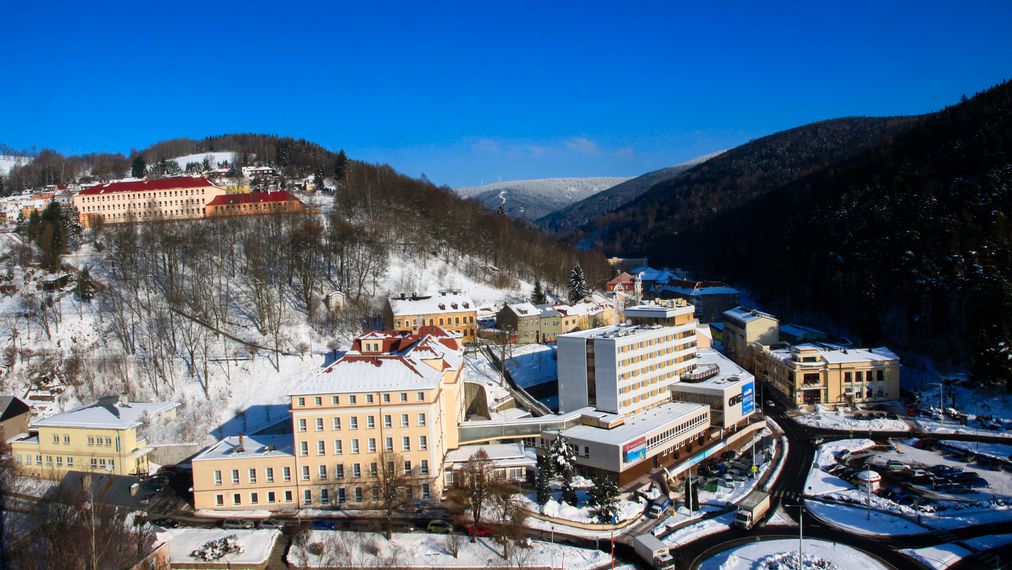
Jáchymov is a small town of 3,000 in a forested mountain landscape. The spa hotels are scattered through the town and surrounding woods. There are no colonnades, no concert halls, no promenades — Jáchymov is not a spa resort for strolling and socialising. It is a focused medical facility for patients with serious inflammatory joint diseases who are seeking a treatment that exists nowhere else in Central Europe. The mountain air at 700 metres is clean and crisp — ideal for the walking therapy that accompanies the radon treatment.
Attractions Near Jáchymov
– 🏛 Radium Palace — the world’s first radon spa hotel, Art Nouveau, opened 1906 – ⛏ Svornost Mine — oldest still-operating uranium mine, visitor gallery with radon inhalation – 📖 Coin Museum — the Joachimsthaler was minted here from 1520, giving the dollar its name – 🏰 Hauenstein Castle — medieval ruin overlooking the town – 🌲 Ore Mountains — hiking trails, winter cross-country skiing, Klínovec peak at 1,244 m
Getting to Jáchymov from Germany
Jáchymov lies in the Bohemian Ore Mountains on the Saxon border. From Dresden it is 130 kilometres (2 hours) — the route climbs through forested mountain roads, scenic but winding. From Nuremberg it is 200 kilometres (2 hours 30 minutes). The door-to-door transfer with German-speaking driver is strongly recommended due to the mountain approach. The nearest railway station is Ostrov nad Ohří (10 km). Karlovy Vary International Airport is 25 kilometres away.
A Typical Spa Day in Jáchymov
| Time | Activity |
|---|---|
| 07:30 | Rise — glass of water |
| 08:00 | Breakfast |
| 09:00 | Radon bath — 20 minutes at 36–38 °C |
| 09:30 | Rest period — 30 minutes in the rest room |
| 10:00 | Physiotherapy — active joint mobilisation |
| 11:30 | Walk in the spa park — 30 minutes |
| 12:30 | Lunch |
| 14:00 | Radon inhalation — 15 minutes |
| 15:00 | Massage or manual therapy |
| 16:30 | Drinking cure or second rest period |
| 17:30 | Dinner |
| 19:00 | Evening walk — view of the Ore Mountains |
Frequently Asked Questions
Is radon therapy dangerous?
No — the dose is extremely low. A 20-minute radon bath equals roughly the radiation exposure of a dental X-ray or a long-haul flight. The entire three-week course of 15 baths delivers 1.5–3 millisieverts — less than the natural annual background radiation in Germany (2.1 mSv). Over a century of documented use since 1906, no elevated cancer rates have been observed in Jáchymov spa patients. The radon is completely eliminated from the body within hours after each bath — it does not accumulate.
How long does the effect of radon therapy really last?
The anti-inflammatory and pain-relieving effect of a course of 15 radon baths lasts six to twelve months. Many patients with rheumatoid arthritis and Bechterew’s disease remain largely symptom-free between annual courses. The effect is not placebo — it is a documented activation of the body’s own anti-inflammatory enzyme systems that persists long after the radon has left the body.
Why only two radon spas in the network?
Natural radon sources with therapeutically usable concentration are geologically extremely rare. They occur only where uranium-bearing rock, thermal water and natural shielding coincide. Jáchymov and Świeradów-Zdrój in Poland are the only radon spas in our programme — together they serve the entire demand for radon therapy in Central Europe.
Is Jáchymov suitable for non-rheumatic patients?
No — the radon therapy is specifically indicated for inflammatory and degenerative joint diseases. For other indications — digestion, kidneys, respiratory — the Czech Triangle spas or Luhačovice are more appropriate. 1 — see all comparisons.
Note: This information is for general guidance only and does not replace individual medical advice or diagnosis by a physician.

Author: Kuropa Editorial Team
Expert review: Anastasia Folak, Head of Spa Advisory
15+ years of experience in spa travel consulting
More about our expertise →