
🛡️ No Prepayment
Pay only on arrival
🚗 Door-to-Door Transfer
Directly to the hotel
🏥 Expert Care
English-speaking support
Key Facts
– Over 130 thermal springs in Budapest alone — more than any other capital city in the world – Hévíz Thermal Lake — 4.4 hectares, 38 °C year-round, the world’s largest biologically active thermal lake – Ottoman bathing heritage — Rudás and Király baths from the 16th century, still in operation – Gellért and Széchenyi Baths — among the most beautiful thermal bath complexes in Europe – Underwater traction invented in Hévíz in 1953 — the gentlest method of spinal decompression – German-speaking doctors and medical staff in all spa hotels – No prepayment — pay at the hotel, book your Hungary cure without risk
Hungary at a Glance
| Feature | Details |
|---|---|
| Spas | 2 (Budapest, Hévíz) |
| Springs | 130+ in Budapest alone |
| Water | Calcium-magnesium-hydrogen-carbonate, CO₂, sulfur, fluoride, boron |
| Signature Baths | Gellért (Art Nouveau 1918), Széchenyi (Neo-Baroque 1913), Rudás (Ottoman 1550) |
| Thermal Lake | Hévíz — 4.4 ha, 38 m deep, 38 °C, never freezes |
| Unique Invention | Underwater traction — developed in Hévíz, 1953 |
| Kurdauer | 7–21 days |
Spa Resorts in Hungary
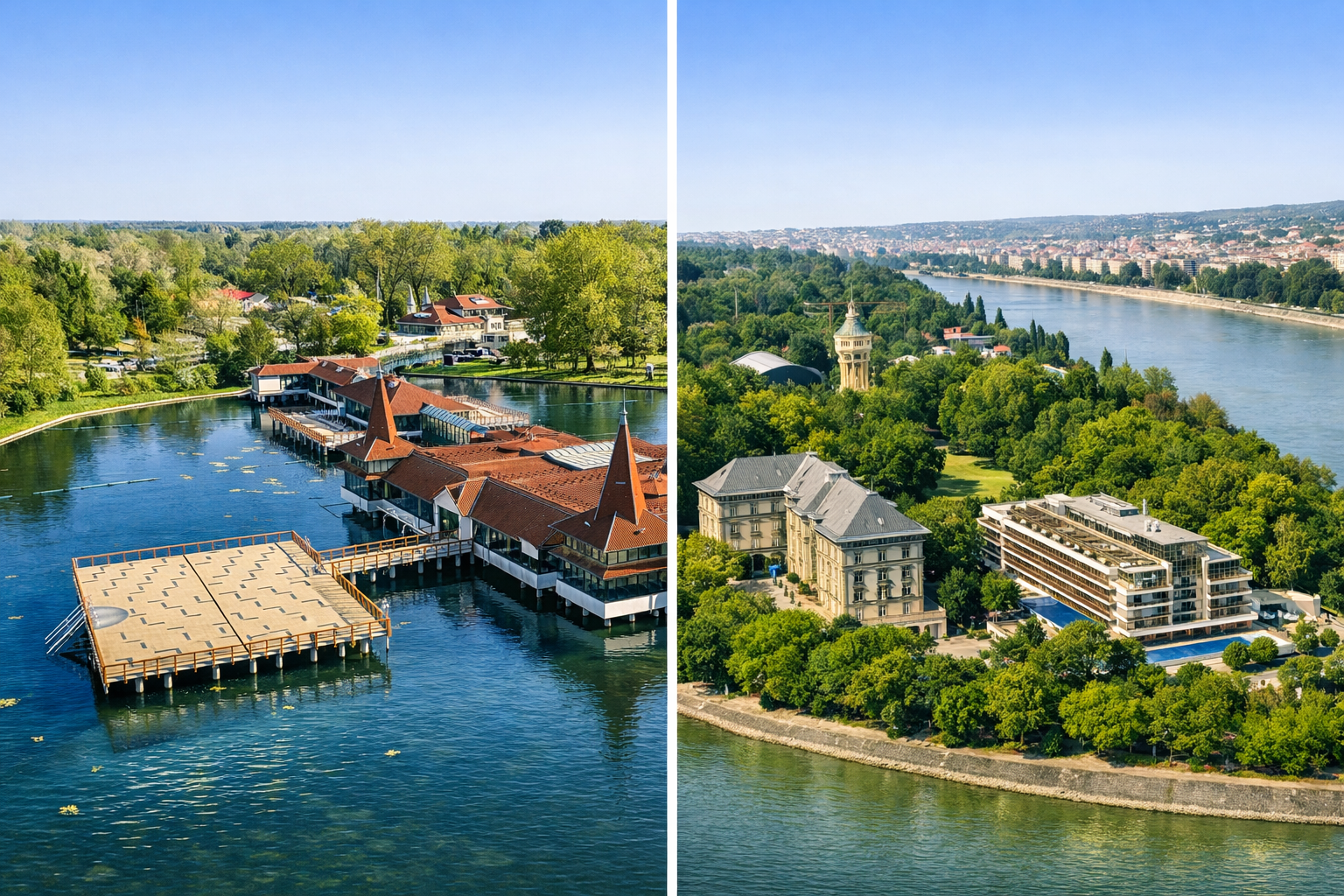
Budapest — the City of Baths. No other capital in the world has thermal water running through its veins like Budapest. Over 130 springs feed the city’s bathhouses — from the Gellért Bath, an Art Nouveau masterpiece of mosaics, marble columns and glass-domed swimming halls completed in 1918, to the Széchenyi Bath, Europe’s largest thermal complex with 18 pools, to the Rudás Bath, an octagonal Ottoman jewel built in 1550 where the original stone cupola still arches over the thermal pool. The water — calcium-magnesium-hydrogen-carbonate with 1.8 g/l mineralisation and 375 mg/l natural CO₂ — treats the musculoskeletal system, digestion and cardiovascular health.
Budapest is not a retreat from the world — it is a medical spa woven into urban life. You take your morning cure in a 100-year-old thermal hall, then walk across the Chain Bridge to the Castle District for lunch. Locals use the baths the way Parisians use cafés — it is part of the daily rhythm. This urban-spa duality makes Budapest uniquely suited for guests who want effective spa treatment without isolating themselves from culture and city life.
Hévíz — the world’s largest natural thermal lake. At 4.4 hectares and 38 metres deep, this volcanic lake never freezes: 38 °C water rises from a spring at the bottom at 410 litres per second, exchanging the entire volume every 72 hours. The water is rich in sulfur, calcium, magnesium and hydrogen carbonate, with a mild natural radioactivity from radon traces. Tropical red water lilies — Nymphaea rubra, introduced from India in 1898 — bloom year-round on the surface, their roots anchored in the lake floor.
The underwater traction technique was invented here in 1953: the patient is suspended vertically in 38 °C water, spine stretched by body weight, muscles fully relaxed by the warmth — no painful counter-reflexes, no pharmaceutical muscle relaxants. It remains the gentlest and most effective treatment for herniated disc and chronic back pain in European balneology. The mud from the lake bottom, applied as a warm pack, adds sulfur compounds and organic acids that regenerate cartilage.
Spa Resorts Compared
| Spa | Springs/Water | Temperature | Speciality |
|---|---|---|---|
| Budapest ★★ | 130+ springs, Ca-Mg-HCO₃, CO₂ | 22–77 °C | Musculoskeletal, Digestion, General Rehabilitation |
| Hévíz ★★★ | Thermal lake, sulfur, radon traces | 38 °C year-round | Musculoskeletal ★★★, Rheumatology, Herniated Disc |
Treatments in Hungary
Thermal bath in Budapest: The communal bath experience. At Gellért, 15 indoor pools and three outdoor pools at 27–40 °C, fed by the 77 °C St. Stephen’s Spring from 1,256 metres underground. At Széchenyi, Europe’s largest outdoor thermal pool — 38 °C water steaming in winter air while snow falls around you. The minerals are absorbed through the skin, the heat relaxes skeletal muscles, and the buoyancy reduces joint load by 90 percent. Thermal bath treatment — learn more.
Underwater traction in Hévíz: The patient is fixed vertically in 38 °C thermal water and gently stretched by body weight. The heat eliminates muscle guarding — the intervertebral discs decompress without resistance. Three sessions per week, 20 minutes each. Results are most pronounced for herniated disc, chronic back pain and Bechterew’s disease.
Lake bathing in Hévíz: Unlike a 20-minute thermal bath, you can stay in the lake for 30–40 minutes — the massive water volume and constant flow prevent overheating. You move slowly, half-swimming or hanging from a bar, while the water does the therapeutic work. In winter, a heated covered walkway leads from the bathhouse directly into the steaming lake — bathing in 38 °C water at 0 °C air temperature is an unforgettable experience.
Drinking cure: The St. Stephen’s Spring at Gellért produces drinking water used for chronic gastritis and digestive disorders. The Hévíz thermal water is also prescribed as a drinking cure for metabolic conditions and gout.
History and Spa Tradition
Budapest’s bathing culture predates Hungary itself. The Romans built baths in Aquincum — Roman Budapest — in the 2nd century AD. But the city’s thermal identity was forged during the 150 years of Ottoman rule starting in 1541. The Turks built domed bathhouses over the springs — Rudás (1550) and Király (1565) are still in operation, among the very few original Turkish baths outside Turkey where you can bathe under a 500-year-old stone cupola pierced with coloured glass stars.
The Grand Baths arrived around 1900. Gellért, opened in 1918, and Széchenyi, opened in 1913, were statements of imperial ambition — Budapest’s answer to the bathing palaces of Rome and Baden-Baden. In the interwar period, Budapest became the spa capital of Central Europe, attracting patients and pleasure-seekers from Vienna, Berlin and beyond.
Hévíz has a longer, quieter history. The Romans already used the lake — coins found on the lake floor date to the 2nd century. The first bathhouse was built in the 18th century. The underwater traction technique, developed in 1953 by Hungarian physicians, placed Hévíz on the world map of medical balneology. Today, ten spa hotels ring the lake, each with direct access to the water.
Typical Spa Day in Hungary (Budapest)
| Time | Activity |
|---|---|
| 07:30 | Rise — walk to the thermal bath |
| 08:00 | Thermal bath — 20–30 minutes at Gellért or Széchenyi |
| 09:00 | Breakfast in the spa hotel |
| 10:00 | Physiotherapy or medical massage |
| 11:30 | Drinking cure at St. Stephen’s Spring |
| 12:30 | Lunch |
| 14:00 | CO₂ bath or second thermal session |
| 15:30 | City walk — Castle District, Chain Bridge, Danube promenade |
| 17:30 | Dinner |
| 19:00 | Evening walk — illuminated Parliament across the Danube |
Typical Spa Day in Hungary (Hévíz)
| Time | Activity |
|---|---|
| 07:30 | Rise — light morning stretching |
| 08:00 | Breakfast |
| 09:00 | Bathing in the thermal lake — 30 minutes among water lilies |
| 10:00 | Underwater traction or physiotherapy |
| 11:30 | Walk around the lake — protected forest path |
| 12:30 | Lunch |
| 14:00 | Mud pack from lake sediment — 20 minutes |
| 15:00 | Rest on the sun terrace overlooking the lake |
| 16:30 | Second lake bathing session (if prescribed) |
| 17:30 | Dinner |
| 19:00 | Evening walk at the lake shore |
Frequently Asked Questions
Is Budapest a real spa or just a thermal city?
Both — and that is precisely its value. The Gellért and Széchenyi baths are fully equipped medical spa facilities with spa doctors and individualised treatment plans. At the same time, Budapest is a world capital of two million people. You complete your morning cure and spend the afternoon in a city with opera, galleries and restaurants — a combination no other European spa resort offers.
Which Hungarian bath is best for a medical cure?
Gellért has 15 indoor pools and an attached spa hotel — ideal for a structured cure with daily treatments. Széchenyi is larger, livelier, and better for independent bathing. Rudás is quieter, more atmospheric, and the water is the least chemically treated of all Budapest baths — purists prefer it.
Can you swim in the Hévíz lake normally?
No — fast swimming is discouraged because it counteracts the therapeutic effect of slow, relaxed muscle engagement. You move gently, half-floating, often holding a bar. Bathing caps are mandatory to prevent hair from entering the filtration system. The lake is not a swimming pool — it is a living ecosystem where the therapy is in the stillness.
Are there German-speaking doctors?
In Budapest, German is spoken at the international spa hotels and at Gellért. At Hévíz, the spa doctors speak German — the resort has a long history of German and Austrian guests. German-speaking care is standard at both locations.
Can Budapest and Hévíz be combined?
Ideally — the transfer between Budapest and Hévíz takes about two hours. A one-week Budapest stay for culture and general thermal treatment followed by one or two weeks at Hévíz for intensive musculoskeletal therapy is a perfect Hungarian combination. Compare Hungarian spas — see all comparisons.
Note: This information is for general guidance only and does not replace individual medical advice or diagnosis by a physician.

Author: Kuropa Editorial Team
Expert review: Anastasia Folak, Head of Spa Advisory
15+ years of experience in spa travel consulting
More about our expertise →