
🛡️ No Prepayment
Pay only on arrival
🚗 Door-to-Door Transfer
Directly to the hotel
🏥 Expert Care
English-speaking support
Key Facts
– 3 spa resorts — Kołobrzeg (Baltic Sea), Świnoujście (44 islands), Świeradów-Zdrój (Iser Mountains) – Highest iodine concentration on the Polish Baltic coast — powerful natural inhalation for respiratory diseases – Iodine-bromine brine springs — own sources at both sea resorts, used for baths and graduation towers – Poland’s only radon spa — Świeradów-Zdrój, radon from granite formations, 1.5–2.5 kBq/l – Widest beach in Poland — Świnoujście, up to 200 metres of white sand – German-speaking doctors and medical staff in all spa hotels – No prepayment — pay at the hotel, book your Poland cure without risk
Poland at a Glance
| Feature | Details |
|---|---|
| Spas | 3 (Kołobrzeg, Świnoujście, Świeradów-Zdrój) |
| Healing Factors | Baltic Sea climate, iodine-bromine brine, peat moor, radon water, sea mud |
| Iodine | Highest concentration on the Polish Baltic coast |
| Radon | Świeradów-Zdrój — 1.5–2.5 kBq/l, granite-source |
| Signature Treatment | Graduation tower inhalation, brine baths, thalassotherapy |
| Kurdauer | 14–21 days recommended |
Spa Resorts in Poland
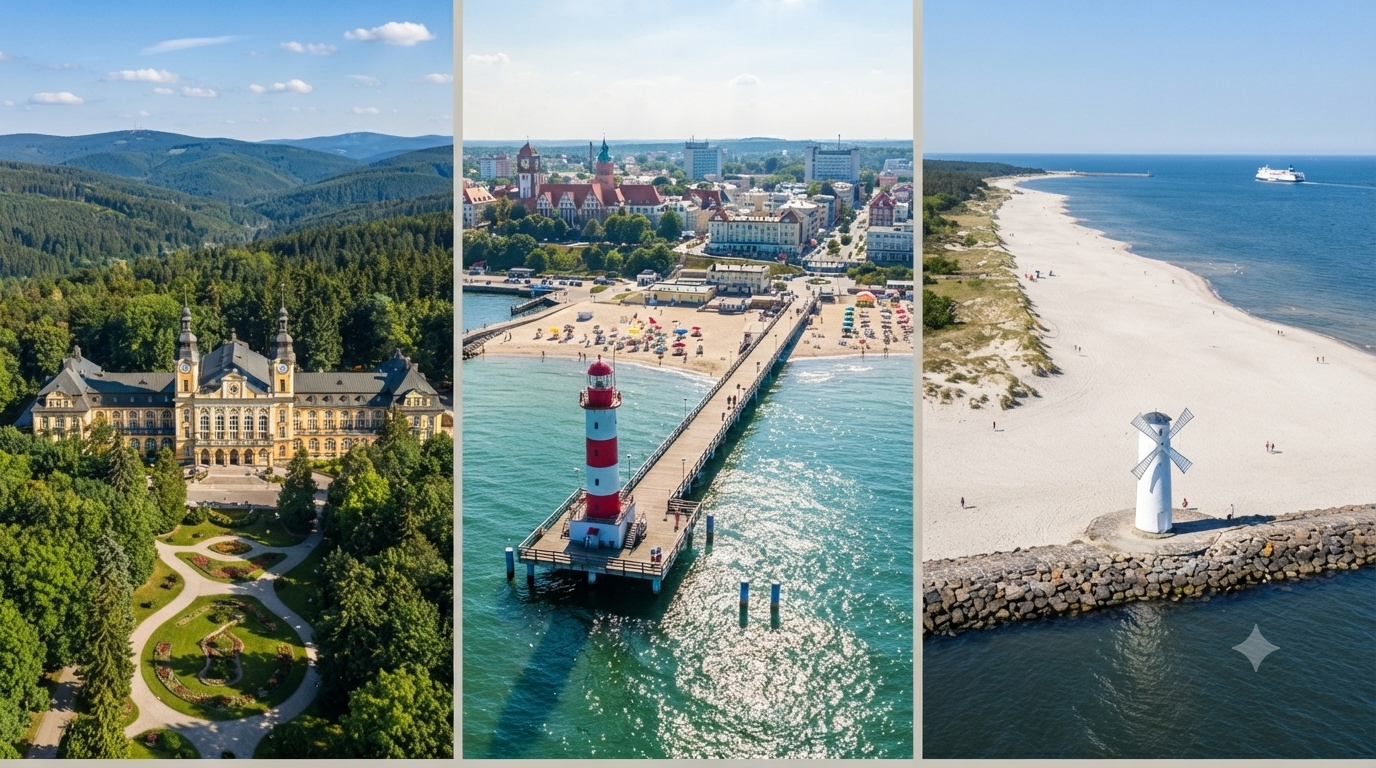
Kołobrzeg — the leading Baltic spa in Poland. The healing power here is the sea itself: iodine-rich Baltic aerosol released by the surf, inhaled with every breath. The iodine concentration in the air at Kołobrzeg is among the highest measured on any Baltic coastline — a natural treatment for chronic bronchitis, asthma and COPD that requires no apparatus, just time spent walking on the 12-kilometre sandy beach. The town’s own iodine-bromine brine spring feeds graduation towers — massive wooden structures over which the brine trickles, creating a microclimate of salt-saturated air around them. Patients spend 30–45 minutes near the towers, breathing in the fine saline mist that reaches the deepest bronchial branches.
The thalassotherapy programme at Kołobrzeg is the most comprehensive on the southern Baltic: sea-water baths, algae packs, and sea mud from the Baltic seabed applied as warm packs for joints and skin. Psoriasis and neurodermatitis respond remarkably well to the combination of iodine-rich air, brine baths and moderate sun exposure. Kołobrzeg also has more than a thousand years of urban history — the Gothic St. Mary’s Cathedral, Prussian fortress ramparts, and a lighthouse from 1947.
świnoujście — the spa on 44 islands. The approach itself is therapeutic: you cross the Świna River by ferry, leaving the mainland — and the everyday — behind. Located at the northern tip of Usedom island directly on the German border, Świnoujście has Poland’s widest beach — up to 200 metres of fine white sand — and the highest iodine concentration on the entire Polish coast. On the beach, you can walk to Ahlbeck, Germany — a cross-border stroll between two countries.
The spa district operates its own iodine-bromine brine spring and graduation towers. The insular location — surrounded by water on all sides — creates a protected maritime microclimate with exceptionally clean air. The 68-metre lighthouse is the tallest on the Polish coast, and the iconic Stawa Młyny windmill beacon at the Świna mouth is the symbol of the resort. Świnoujście is the best spa for respiratory and skin treatment on the Polish coast — quieter than kołobrzeg, with a more intimate island atmosphere.
Świeradów-Zdrój — Poland’s only radon spa. Nestled in the Iser Mountains at 450–600 metres, just a few kilometres from the Czech and German borders, Świeradów-Zdrój deploys radon-containing thermal water from natural granite formations — unlike jáchymov’s mine-sourced radon water. The concentration of 1.5–2.5 kBq/l is therapeutically ideal: strong enough for measurable anti-inflammatory effect, low enough for safe application. The alpha radiation activates the body’s production of superoxide dismutase and catalase — enzymes that neutralise the free radicals overproduced during chronic inflammation.
The spa combines radon baths with Iser Mountain peat moor packs — the humic acids and organic compounds from the high-mountain bogs penetrate deep into joint tissue — and natural co₂ baths that dilate capillaries and lower blood pressure. Świeradów-Zdrój is the best spa for rheumatology and arthrosis in Poland — a quieter, more affordable alternative to Jáchymov for patients with rheumatoid arthritis and chronic pain syndromes.
Spa Resorts Compared
| Spa | Healing Factor | Speciality |
|---|---|---|
| Kołobrzeg ★★ | Baltic Sea, iodine-bromine brine, thalassotherapy | Respiratory ★★★, Dermatology ★★★, Cardiovascular |
| Świnoujście ★★ | Baltic Sea (highest iodine), 44 islands, brine springs | Respiratory ★★★, Dermatology ★★★, Burnout |
| Świeradów-Zdrój ★★ | Radon water 1.5–2.5 kBq/l, Iser peat moor, CO₂ | Rheumatology ★★, Arthrosis, Gynaecology |
Treatments in Poland
Graduation tower inhalation: The signature treatment of the Polish Baltic coast. Brine — highly concentrated salt water from the spa’s own spring — trickles down massive wooden structures, breaking into a fine aerosol. The surrounding air becomes saturated with iodine, bromine and salt particles that reach the deepest alveoli of the lungs. A 30–45 minute session near the tower — sitting on a bench, reading or simply breathing — is one of the most effective natural treatments for chronic bronchitis and COPD. Inhalation treatment — learn more.
Brine bath: The iodine-bromine water at 22–28 °C is used as a full bath. The iodine penetrates the upper skin layers and calms itching and inflammation — particularly effective for psoriasis, neurodermitis and eczema. The bromine has a sedative effect on the nervous system, improving sleep. At Kołobrzeg and Świnoujście, brine baths are prescribed daily or every second day for 15–20 minutes.
Radon bath and inhalation: At Świeradów-Zdrój, the radon bath at 36–38 °C for 20 minutes is the core therapy. After bathing, a 30-minute rest period allows the radon to distribute through the body. Radon inhalation in a special chamber delivers the alpha-emitter directly to the bloodstream via the lungs, complementing the transdermal absorption from the bath. The anti-inflammatory effect lasts six to twelve months after a course of 10–15 baths.
Baltic thalassotherapy: At both sea resorts, sea-water baths, algae packs and Baltic sea mud from the seabed are applied as warm packs. The mud, rich in iodine and bromine, is heated to 42 °C and applied to joints affected by arthrosis. The combination of thalassotherapy and Baltic climate is unique to the Polish coast.
History and Spa Tradition
Kołobrzeg was already a settlement in the 9th century and became a major Hanseatic trading port by the 13th century. It entered history in 1807 as the only Prussian fortress to withstand Napoleon’s siege — the defence became a national legend that was later turned into a Nazi propaganda film in 1945, ironically just before the city was destroyed and became Polish. The spa tradition began in the 19th century when Berlin’s bourgeoisie discovered the Baltic coast, and a direct railway — the “Bäderbahn” — brought thousands of guests from Berlin to the sea.
Świnoujście was a fishing village on Usedom until the Prussian King Friedrich Wilhelm III ordered the construction of a spa resort in 1824. The Kaiserdamm — a grand avenue leading to the beach — and the railway connection from Berlin transformed it into a fashionable Baltic spa destination. After 1945, the city became Polish and developed into the leading spa of West Pomerania.
Świeradów-Zdrój was developed as Bad Flinsberg by German and Austrian aristocracy in the 19th century. Its radon springs, clean mountain air, and protected forest setting attracted guests from Berlin, Dresden and Breslau. After 1945, it became Polish and continued its radon therapy tradition — today it draws patients from across central Europe.
Typical Spa Day in Poland (Baltic)
| Time | Activity |
|---|---|
| 07:30 | Rise — morning walk on the beach |
| 08:00 | Breakfast |
| 09:00 | Graduation tower inhalation — 30–45 minutes |
| 10:00 | Brine bath — 20 minutes |
| 11:00 | Beach walking — 1 hour, barefoot in wet sand |
| 12:30 | Lunch |
| 14:00 | Mud pack or algae wrap — 20 minutes |
| 15:00 | Massage or physiotherapy |
| 16:30 | Promenade walk — cafés, sea views |
| 17:30 | Dinner |
| 19:00 | Evening walk — sunset on the Baltic |
Frequently Asked Questions
Why choose a Polish Baltic spa over a German one?
The Polish Baltic coast has a higher natural iodine concentration in the air, wider and less crowded beaches, and more comprehensive thalassotherapy programmes with their own brine springs. Polish spa resorts are also significantly more affordable than comparable German seaside resorts — and all offer German-speaking care.
Which Polish spa is best for psoriasis?
Both Kołobrzeg and Świnoujście deliver excellent results for psoriasis and neurodermitis through the combination of iodine-rich air, brine baths and moderate sun exposure. Świnoujście has the edge for air quality because of its insular location, while Kołobrzeg has more extensive thalassotherapy facilities.
Is the radon therapy in Świeradów-Zdrój safe?
Yes — the dose is extremely low. Twenty minutes in a radon bath at 2 kBq/l equals roughly the radiation exposure of a dental X-ray. A full course of 15 baths delivers less than the natural annual background radiation in Germany. Over a century of documented use, no elevated cancer rates have been recorded among spa patients.
Can I walk from Świnoujście to Germany?
Yes — the beach is continuous. The walk from the Świnoujście promenade to Ahlbeck in Germany takes about an hour along the sand. It is one of the few places in Europe where you can walk between two countries on a beach — no border control, just sand and sea. Compare Polish spas — see all comparisons.
Note: This information is for general guidance only and does not replace individual medical advice or diagnosis by a physician.

Author: Kuropa Editorial Team
Expert review: Anastasia Folak, Head of Spa Advisory
15+ years of experience in spa travel consulting
More about our expertise →