
🛡️ No Prepayment
Pay only on arrival
🚗 Door-to-Door Transfer
Directly to the hotel
🏥 Expert Care
English-speaking support
Key Facts
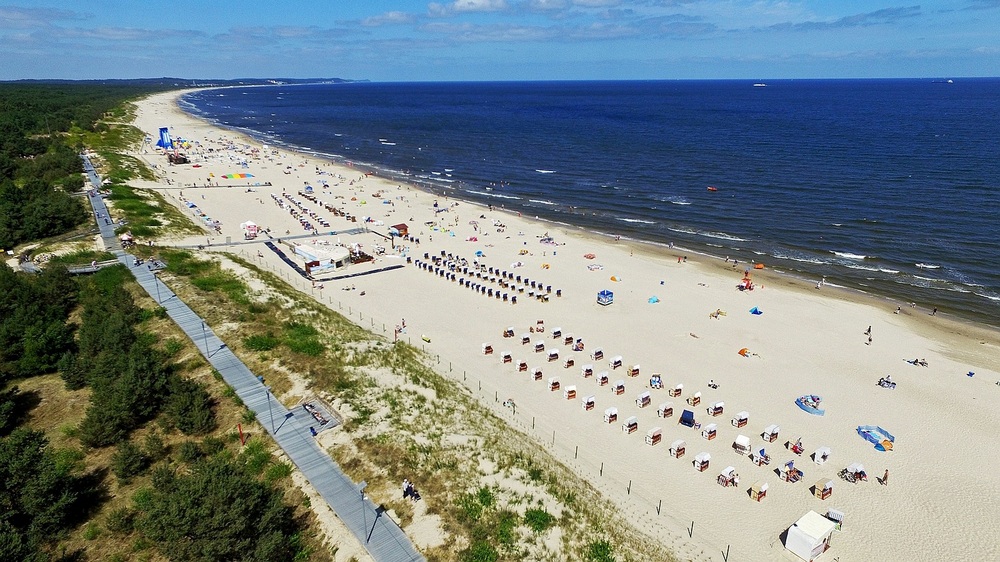
– 44 islands — unique insular spa location, accessed by ferry – Poland’s widest beach — up to 200 m of fine white sand – Highest iodine concentration on the Polish Baltic coast – Iodine-bromine brine spring — own source, 22–28 °C – Cross-border beach walk — Świnoujście to Ahlbeck, Germany, in one hour – Specialisation ★★★ — respiratory, dermatology, cardiovascular, rheumatology – German-speaking doctors and therapists — bilingual German-Polish tradition – No prepayment — pay at the hotel on arrival
Świnoujście at a Glance
| Feature | Details |
|---|---|
| Location | 44 islands at the Świna River mouth, Usedom |
| Healing Factors | Baltic Sea climate, iodine-bromine brine, peat moor, sea mud |
| Iodine | Highest concentration on the Polish Baltic coast |
| Beach | Up to 200 m wide, finest white sand |
| Brine Spring | Own iodine-bromine source |
| Specialisation | Respiratory ★★★, Dermatology ★★★, Cardiovascular ★★ |
| Unique Feature | The only spa resort accessed by ferry |
| Kurdauer | 14–21 days recommended |
What Does Świnoujście Treat?
Świnoujście is a Baltic spa with a focus on respiratory and skin diseases — the highest iodine concentration on the coast and the wide, fine sandy beach create ideal conditions.
– Chronic bronchitis, asthma — iodine-rich sea air and brine inhalation in graduation towers (★★★) – COPD — salt aerosol cleanses bronchi, facilitates expectoration (★★★) – Psoriasis, neurodermitis — Baltic climate, brine baths and sun on the wide beach (★★★) – Allergies — pollen-poor island sea air reduces allergen load – cardiovascular diseases — dosed beach walking – Rheumatism, arthrosis — warm brine baths and peat moor packs – Burnout, stress — island seclusion, sea sounds, beach solitude
The Healing Factors of Świnoujście
| Factor | Property | Effect |
|---|---|---|
| Baltic Sea Climate | Highest iodine concentration in Poland, insular clean air | Deep inhalation — iodine liquefies mucus, saline surf cleanses airways |
| Iodine-Bromine Brine | Own spring, 22–28 °C | Baths calm skin, relax muscles |
| Graduation Towers | Wooden structures, atomised brine | Salt aerosol inhalation — 30–45 minutes daily |
| Sea Mud | From Baltic seabed, iodine and bromine | Packs for joints and skin |
| Peat Moor | Island moor, humic acids | Deep heat for the musculoskeletal system |
Treatments in Świnoujście
Brine bath: The iodine-bromine water from świnoujście’s own spring is used as a full bath at 22–28 °C. The iodine penetrates the upper skin layers and calms itching and inflammation — particularly effective for psoriasis and neurodermitis. The bromine sedates the nervous system — ideal for stress-related conditions and sleep disorders. Baths are prescribed daily or every second day.
Graduation tower inhalation: The Świnoujście graduation towers — massive wooden structures over which brine trickles — generate a fine salt aerosol that intensively cleanses the airways. The patient spends 30–45 minutes near the towers, breathing in the iodine- and salt-saturated air. The fine salt particles reach the deepest bronchial branches. 1 — learn more.
Beach walking on Usedom: Daily walking on the wide Usedom beach — barefoot in the wet, fine sand — is the most intensive natural inhalation therapy on the Baltic. The surf aerosol releases large quantities of iodine, the wet sand stimulates the foot reflex zones, and the expansive beach invites extended walks. The beach is continuous — you can walk for hours without turning back.
Thalasso packs: Sea mud from the Baltic seabed and algae from the Pomeranian Bay are applied as warm packs to joints and skin. The iodine and bromine compounds of the sea are absorbed transdermally, directly into the tissue.
History and Atmosphere
Świnoujście was originally a small fishing village on Usedom. Its rise as a seaside resort began in 1824, when the first bathers from Berlin and Szczecin discovered the healing effect of the Baltic air. The construction of the railway from Berlin and the Kaiserdamm — a grand avenue leading to the beach — transformed Świnoujście into a fashionable Baltic resort for the well-to-do bourgeoisie. After 1945, the town became Polish and developed into the leading spa of West Pomerania.
Today, Świnoujście is a city of 40,000 on three inhabited islands — Usedom, Wolin and Kaseburg — with 41 further uninhabited islands. Reaching it by ferry across the Świna is an experience in itself, symbolically separating the spa stay from the everyday. The wide white beach, the promenade with cafés and restaurants, and the view of passing ships define the atmosphere. Via the beach, you can walk to the German seaside resorts of Ahlbeck and Heringsdorf — a unique cross-border walk between two countries along the sand.
Attractions Near Świnoujście
– 🏛 Stawa Młyny — the iconic windmill beacon at the Świna mouth, symbol of Świnoujście – 🗼 Lighthouse — tallest on the Polish Baltic coast (68 m), observation platform – 🌊 Beach Promenade — wide promenade with cafés and Baltic Sea views – 🧂 Graduation Towers — historic and modern salt works in the spa park – 🏰 Fort Gerharda — Prussian fortress from the 19th century, museum – 🌉 Ahlbeck — the neighbouring German seaside resort, reachable on foot along the beach
Getting to Świnoujście from Germany
Świnoujście lies directly on the German border on Usedom. From Germany, you reach the resort via the German side of the island — from Ahlbeck (Germany) to Świnoujście (Poland) it is only 3 kilometres. From Berlin it is 250 kilometres (3 hours), from Hamburg 350 kilometres (4 hours). The door-to-door transfer with German-speaking driver brings you directly to the ferry and, after the crossing, to the spa hotel. Alternatively, the Usedomer Bäderbahn (UBB) connects Ahlbeck with Świnoujście.
A Typical Spa Day in Świnoujście
| Time | Activity |
|---|---|
| 07:30 | Rise — morning walk on the deserted beach |
| 08:00 | Breakfast |
| 09:00 | Graduation tower inhalation — 30 minutes |
| 10:00 | Brine bath — 20 minutes |
| 11:00 | Beach walking — 1 hour, barefoot in wet sand |
| 12:30 | Lunch |
| 14:00 | Mud pack or algae wrap |
| 15:00 | Massage or physiotherapy |
| 16:30 | Walk to Ahlbeck — along the beach into Germany |
| 17:30 | Dinner |
| 19:00 | Evening walk — sunset at the Świna mouth |
Frequently Asked Questions
Do I need a passport for Świnoujście?
Poland is an EU member — a national ID card is sufficient. You can enter Świnoujście from the German side of Usedom on foot along the beach or by ferry. There is no border control — just sand, sea and the crossing.
Why choose Świnoujście over the German Baltic resorts?
Świnoujście has a wider, finer sandy beach, a higher iodine concentration in the air, and a more comprehensive spa programme with its own brine spring. It is also significantly more affordable than comparable German seaside resorts — while offering the same or better therapeutic quality. German-speaking care is standard.
Can I walk from Świnoujście to Germany?
Yes — the beach is continuous and passable. The walk from the Świnoujście promenade to Ahlbeck in Germany takes about an hour along the sand — a unique cross-border beach walk between two countries on the Baltic Sea.
Is the island location isolating?
The ferry crossing from the mainland takes only a few minutes. The insularity is therapeutic — the ritual of crossing water symbolically separates the spa stay from everyday life. You are not isolated: the town has 40,000 inhabitants, shops, restaurants, and the German resorts of Ahlbeck and Heringsdorf are within walking distance on the beach. 1 — see all comparisons.
Note: This information is for general guidance only and does not replace individual medical advice or diagnosis by a physician.

Author: Kuropa Editorial Team
Expert review: Anastasia Folak, Head of Spa Advisory
15+ years of experience in spa travel consulting
More about our expertise →