
🛡️ No Prepayment
Pay only on arrival
🚗 Door-to-Door Transfer
Directly to the hotel
🏥 Expert Care
English-speaking support
Key Facts
– Poland’s only radon spa — radon from natural granite formations, 1.5–2.5 kBq/l – Gentler alternative to Jáchymov — lower radon concentration, lower cost – Iser Mountains — 450–600 m, clean forest air, marked hiking trails – Combination therapy — radon baths + peat moor packs + CO₂ baths – Specialisation ★★ — rheumatoid arthritis, arthrosis, gynaecology, chronic pain – German-speaking doctors and therapists — spa doctors speak German – No prepayment — pay at the hotel on arrival
Świeradów-Zdrój at a Glance
| Feature | Details |
|---|---|
| Founded | 16th century, spa since the 19th century |
| Radon Water | 1.5–2.5 kBq/l, from granite formations, 36–38 °C |
| Treatments | Radon bath, radon inhalation, peat Moor Pack, CO₂ bath |
| Specialisation | Rheumatology ★★, Arthrosis, Gynaecology, Chronic Pain |
| Location | Iser Mountains, 450–600 m, near Czech and German borders |
| Kurdauer | 14–21 days (10–15 radon baths per course) |
What Does Świeradów-Zdrój Treat?
Świeradów-Zdrój combines Radon Therapy with classical spa treatments for a broad indication spectrum — particularly suitable for patients seeking an alternative or complement to Jáchymov.
– Rheumatoid arthritis — radon baths activate anti-inflammatory enzymes (★★) – Arthrosis — combined radon and peat moor therapy relieves pain – Bechterew’s disease — radon inhalation and baths improve mobility – Chronic pain syndromes — endorphin release triggered by radon – Gynaecological conditions — peat moor packs for chronic pelvic inflammation – osteoporosis — water-based exercise and mountain air – Fibromyalgia — multimodal pain therapy
The Healing Factors of Świeradów-Zdrój
| Factor | Property | Effect |
|---|---|---|
| Radon Thermal Water | 1.5–2.5 kBq/l, granite-source, 36–38 °C | Alpha radiation activates SOD and catalase — anti-inflammatory |
| Peat Moor | Iser Mountain high-moor, humic acids | Deep heat and organic acids for joints and gynaecological organs |
| CO₂ | Natural carbon dioxide | Vasodilation, blood pressure reduction |
| Mountain Air | 450–600 m, clean, low-allergen | Oxygen-rich air for respiratory and cardiovascular systems |
Treatments in Świeradów-Zdrój
Radon bath: The core therapy. The patient bathes for 20 minutes in 36–38 °C water containing dissolved radon at 1.5–2.5 kBq/l. The alpha particles penetrate about 40 micrometres into the skin and activate the production of superoxide dismutase and catalase — enzymes that neutralise the free radicals overproduced during chronic inflammation. After the bath, a 30-minute rest period allows the radon to distribute through the body. The effect of a course of 10–15 baths lasts six to twelve months. radon therapy treatment — learn more.
Radon inhalation: The patient breathes radon-containing air in a special chamber for 15–20 minutes. Absorption through the lungs delivers the alpha emitter systemically, complementing transdermal absorption from the baths. Inhalation is prescribed two to three times per week.
Peat moor pack: Iser Mountain high-moor peat — rich in humic acids and trace elements — is heated to 42 °C and applied as a full-body or partial pack. The heat and organic acids penetrate deep into tissue, acting directly on joint capsules and connective tissue. A course of 12–15 packs is standard.
CO₂ bath: Natural carbon dioxide from the mountain springs is used in baths at 33–35 °C. The gas dilates capillaries, lowers blood pressure, and improves peripheral circulation — ideal for older patients and those with cardiovascular conditions who cannot tolerate hot thermal baths.
History and Atmosphere
Świeradów-Zdrój has a long German-Polish history. The first bathing huts at the warm springs were built in the 16th century. In the 19th century, the resort — then called Bad Flinsberg — became a popular destination for German and Austrian aristocracy. The fresh mountain air and natural healing springs drew guests from Berlin, Dresden and Breslau (Wrocław). After 1945, the town became Polish and was renamed Świeradów-Zdrój, continuing its radon therapy tradition.
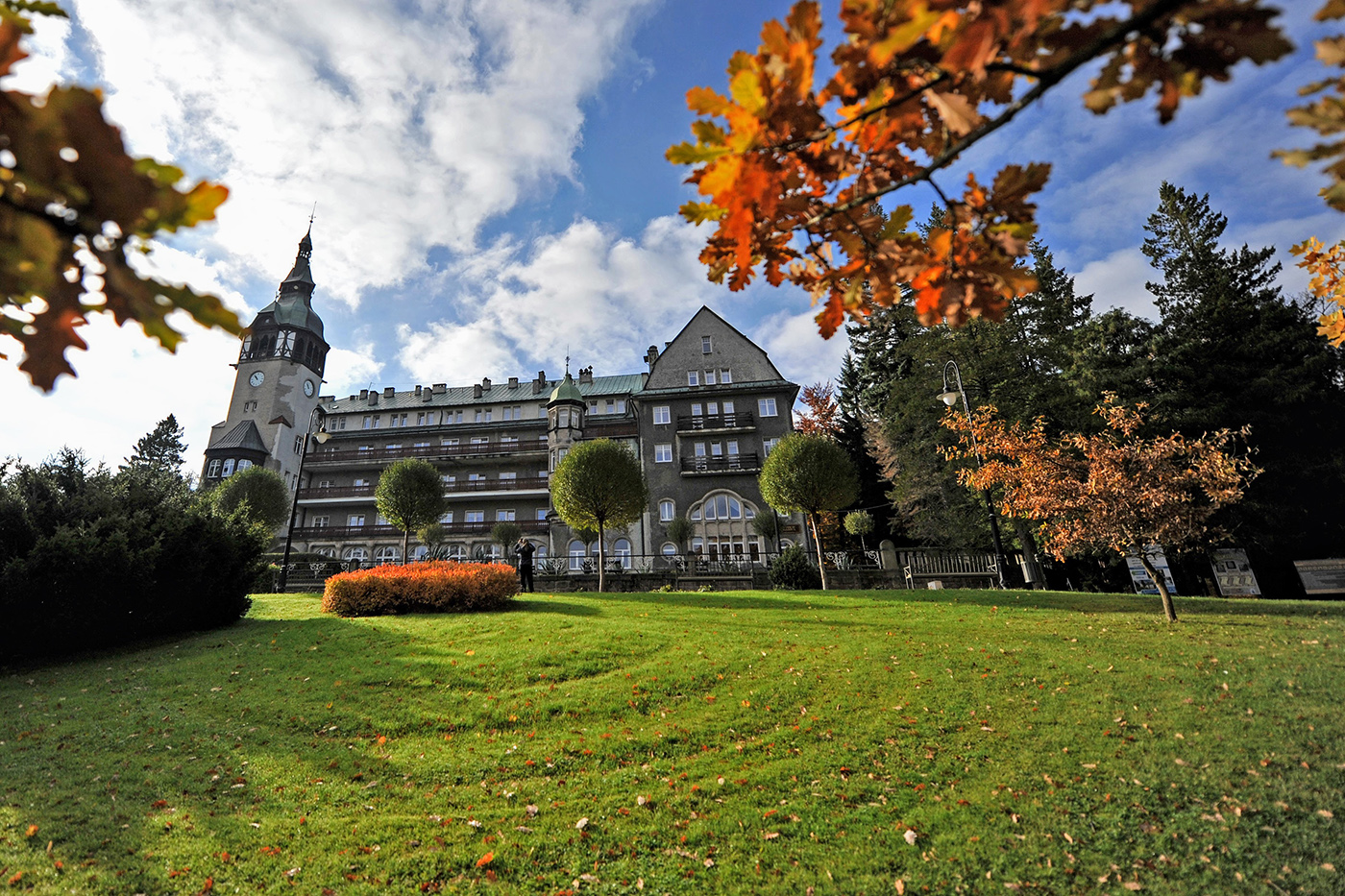
Today, Świeradów-Zdrój is a quiet, compact mountain spa with manicured park grounds, well-preserved 19th-century spa buildings, and a modern spa house. The surrounding Iser Mountains offer marked hiking trails and, in winter, cross-country skiing tracks. The atmosphere is a blend of Silesian tradition, Polish hospitality and Central European spa culture. For guests who want effective radon therapy in a mountain setting, quieter and more affordable than Jáchymov, Świeradów-Zdrój is the right choice.
Attractions Near Świeradów-Zdrój
– 🏛 Spa House — modern spa centre with radon bath department and drinking hall – 🌿 Spa Park — manicured grounds with historic trees and walking paths – ⛪ Timber-Frame Church — one of the few surviving wooden churches of the region – 🌲 Iser Mountains — hiking trails, winter cross-country skiing, observation tower on Heufuder – 🏰 Czocha Castle — imposing 13th-century fortress, 20 km away – 🗿 Tafelfichte — highest Iser Mountain peak at 1,124 m, with observation tower
Getting to Świeradów-Zdrój from Germany
Świeradów-Zdrój lies at the meeting point of the German, Polish and Czech borders — one of the most accessible Polish spas from Germany. From Dresden it is only 130 kilometres (2 hours), from Berlin 270 kilometres (3 hours 30 minutes). The resort is literally 1 kilometre from the Czech border and 15 kilometres from Germany. The door-to-door transfer with German-speaking driver collects you from your home address. The nearest larger railway station is Jelenia Góra (35 km) with connections from Germany via Görlitz.
A Typical Spa Day in Świeradów-Zdrój
| Time | Activity |
|---|---|
| 07:30 | Rise — a glass of water |
| 08:00 | Breakfast |
| 09:00 | Radon bath — 20 minutes at 36–38 °C |
| 09:30 | Rest period — 30 minutes in the rest room |
| 10:00 | Physiotherapy or spa park walk |
| 11:00 | Radon inhalation — 15 minutes |
| 12:30 | Lunch |
| 14:00 | Peat moor pack — 20 minutes |
| 15:00 | Massage or CO₂ bath |
| 16:30 | Mountain hike — 1–2 hours in the Iser Mountains |
| 17:30 | Dinner |
| 19:00 | Evening walk — spa park |
Frequently Asked Questions
Is Świeradów-Zdrój as effective as Jáchymov?
Both use radon but with different intensity. Jáchymov has a higher radon concentration (1–3 kBq/l) and is specialised on the most severe rheumatic diseases. Świeradów-Zdrój offers a gentler radon dose (1.5–2.5 kBq/l) and a broader combination with peat moor packs and CO₂ baths — ideal for patients with arthrosis and moderate rheumatic conditions who want effective treatment in a quieter, more affordable setting.
Can I combine Świeradów-Zdrój with Czech spas?
Ideally — Jáchymov is only 70 kilometres away (1 hour 15 minutes), and the West Bohemian Triangle with Karlovy Vary and Mariánské Lázně is about 200 kilometres. A week at Świeradów-Zdrój followed by a week at Jáchymov is an excellent radon combination therapy.
Are the doctors German-speaking?
Yes — due to the long German history of the resort and its proximity to the German border, the spa doctors speak German. German-speaking care is well established.
Is the Iser Mountains location suitable for winter spa stays?
Yes — the radon baths and moor packs in the warm spa house provide a cosy contrast to the snow-covered mountain landscape. The Iser Mountains have reliable snow cover in winter and are a popular cross-country skiing area. A winter spa stay in Świeradów-Zdrój has a special appeal. Compare Polish spas — see all comparisons.
Note: This information is for general guidance only and does not replace individual medical advice or diagnosis by a physician.

Author: Kuropa Editorial Team
Expert review: Anastasia Folak, Head of Spa Advisory
15+ years of experience in spa travel consulting
More about our expertise →