
🛡️ No Prepayment
Pay only on arrival
🚗 Door-to-Door Transfer
Directly to the hotel
🏥 Expert Care
English-speaking support
Key Facts
• Founded 1908 — purpose-built cardiology spa, the youngest Czech spa resort
• 13 alkaline springs — 12–14 °C, hydrogen-carbonate, CO₂-rich
• Poděbradka mineral water — sold in pharmacies throughout Europe
• Specialisation ★★★ — post-heart attack rehab, bypass recovery, hypertension
• Completely flat terrain — ideal for dosed walking training, no hills or stairs
• German-speaking doctors and cardiologists in all spa hotels
• No prepayment — pay at the hotel on arrival
Poděbrady at a Glance
| Feature | Details |
|---|---|
| Founded | 1908 — purpose-built cardiology spa |
| Springs | 13 alkaline springs, 12–14 °C, hydrogen-carbonate, CO₂ |
| Main Spring | Poděbradka — sold in pharmacies Europe-wide |
| Specialisation | Cardiovascular ★★★, Hypertension ★★★, Post-Heart Attack ★★★ |
| Terrain | Completely flat — Elbe River banks, 190 m altitude |
| Location | 50 km east of Prague |
| Kurdauer | 14–21 days recommended |
What Does Poděbrady Treat?
poděbrady is exclusively specialised on cardiovascular diseases — a focus that is unique among European spa resorts. The infrastructure, medical staff and treatment protocols are all designed for cardiac patients.
– Post-heart attack rehabilitation — controlled recovery, dosed walking training, CO₂ baths (★★★) – Post-bypass surgery — rebuilding physical capacity under cardiological supervision – Hypertension — CO₂ baths measurably and persistently lower blood pressure (★★★) – Coronary heart disease — CO₂ dilates coronary vessels, improves cardiac perfusion – Cardiac arrhythmias — gentle balneotherapy under cardiological monitoring – Peripheral arterial disease — walking training and CO₂ promote collateral vessel formation – diabetes with cardiovascular complications — combined metabolic-cardiac therapy
The Springs of Poděbrady
| Spring | Location | Temperature | Note |
|---|---|---|---|
| Poděbradka | Spa Park Drinking Hall | 12 °C | Alkaline, CO₂-rich, sold in pharmacies as medicinal water |
| Hohenlohe | Hohenlohe Pavilion | 13 °C | High CO₂, strong blood-pressure-lowering effect |
| Bülow | Spa Park | 14 °C | Mild — for drinking cure |
| Rieger | Colonnade | 12 °C | Iron-rich, for red blood cell formation |
| Trnka | New Spa House | 13 °C | Modern tapping, for CO₂ baths |
Treatments in Poděbrady
CO₂ bath: The central treatment. The natural CO₂ from Poděbrady’s springs is used in a full bath at 33–35 °C — cool enough not to burden the cardiovascular system, warm enough for the CO₂ to bubble on the skin. The gas forms tiny pearls that expand capillaries by up to 300 percent. Blood pressure drops measurably within five minutes — a natural vasodilation without pharmaceutical side effects. The bath lasts 15–20 minutes and is prescribed daily or every second day. Poděbrady’s CO₂ baths are among the most intensive in Central Europe, second only to mariánské lázně in CO₂ concentration. CO₂ bath treatment — learn more.
Dosed walking training: The completely flat spa park along the Elbe River is a purpose-built cardiac training ground. Paths are precisely measured and signposted: 500 metres, 1 kilometre, 2 kilometres, 5 kilometres. The patient begins with the 500-metre circuit and increases the distance daily under pulse and blood pressure monitoring. This is the core rehabilitation measure after a heart attack — and Poděbrady’s flat terrain is the best in Europe for it.
Drinking cure with Poděbradka: The alkaline hydrogen-carbonate water is drunk cold — on an empty stomach in the morning and before meals. The hydrogen-carbonate ions buffer excess stomach acid, the CO₂ stimulates gastric secretion, and the dissolved minerals improve electrolyte balance. The drinking cure is particularly important for maintaining mineral homeostasis in cardiac patients.
Cardiac physiotherapy: Specialised heart-circullation gymnastics in small groups under physiotherapist supervision. The focus is on dosed exertion, breathing technique, and stress reduction — all under continuous pulse and blood pressure monitoring.
History and Atmosphere
Poděbrady is a spa resort of the 20th century — no medieval colonnades, no imperial patronage, but a purpose-built modern medical facility. The first mineral spring was discovered in 1905 by the German landowner von Bülow, and the first spa house opened in 1908. From the outset, the resort was oriented toward cardiology — a medical discipline that was emerging as an independent speciality at exactly that moment.
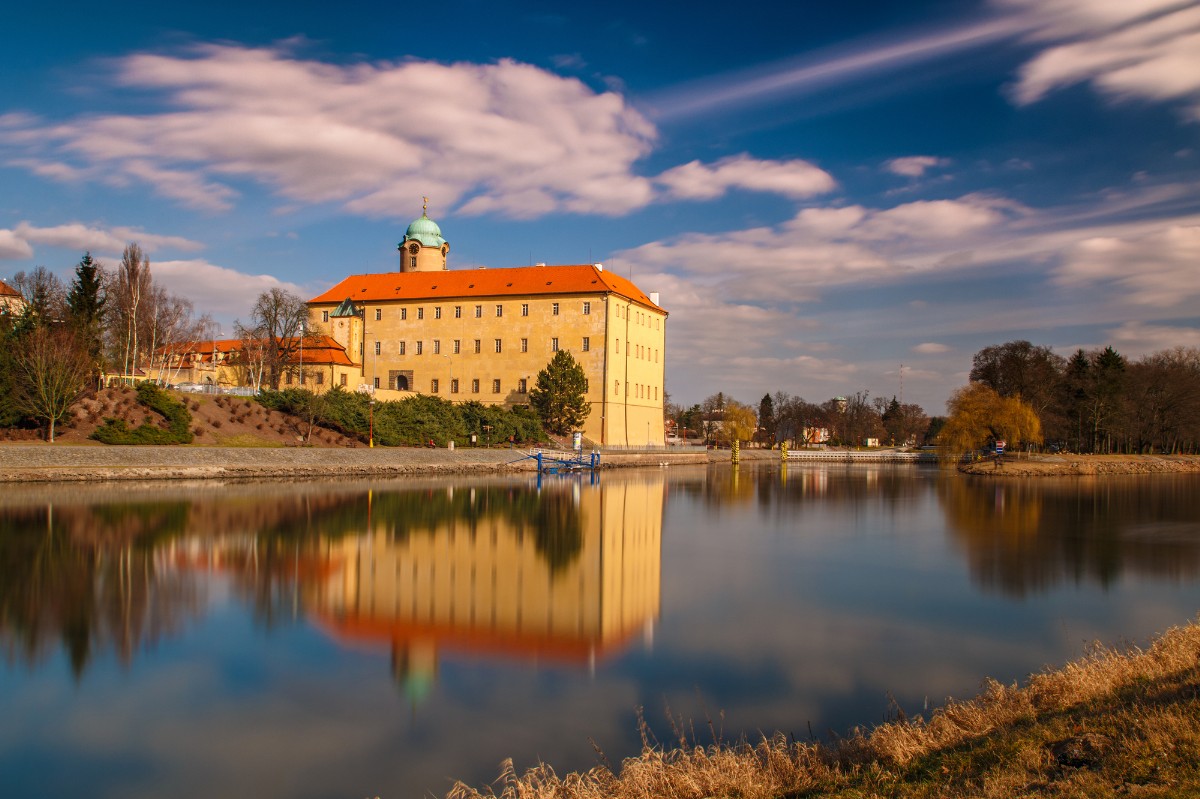
The town of Poděbrady itself has a much older history. Poděbrady Castle — an imposing 13th-century water fortress on the Elbe — was the birthplace of King George of Poděbrady (1420–1471), the only Hussite king of Bohemia and the first European monarch to propose a pan-European peace plan. Today, the castle serves as a hotel and museum.
Poděbrady is a well-maintained, quiet spa town with a spacious flat spa park along the Elbe. Patients in rehabilitation clothing and bathrobes define the street scene. The Flower Clock — a botanical landmark replanted daily — and the modern glass Drinking Hall with all the springs are the central meeting points. For guests who want a focused cardiac rehabilitation in a quiet, flat, green environment, Poděbrady is the first choice.
Attractions Near Poděbrady
– 🏰 Poděbrady Castle — 13th-century water fortress, birthplace of King George of Poděbrady, now a hotel and museum – 🌿 Spa Park — flat, manicured park along the Elbe, measured walking circuits – 🎵 Drinking Hall — modern glass pavilion with all springs – ⛲ Flower Clock — botanical landmark, planted fresh daily – ⛪ Church of the Holy Trinity — Gothic church from the 14th century
Getting to Poděbrady from Germany
Poděbrady lies 50 kilometres east of Prague directly on the D11 motorway. From Dresden it is 210 kilometres (2 hours 30 minutes), from Nuremberg 380 kilometres (4 hours). The door-to-door transfer with German-speaking driver collects you from your home. The resort has its own railway station with regular connections from Prague (40 minutes) and connections to the German ICE network via Prague. Prague Airport is 70 kilometres away — transfer time 50 minutes.
A Typical Spa Day in Poděbrady
| Time | Activity |
|---|---|
| 07:00 | Rise — self-measure blood pressure |
| 07:30 | Drinking cure — Poděbradka at the Drinking Hall |
| 08:00 | Breakfast |
| 09:00 | CO₂ bath — 20 minutes |
| 09:30 | Rest period — 30 minutes |
| 10:00 | Dosed walking training — 1–2 km, pulse-monitored |
| 11:00 | Cardiac physiotherapy — group exercise |
| 12:30 | Lunch |
| 14:00 | Massage or relaxation therapy |
| 15:30 | Second walking session — Elbe River path |
| 17:30 | Dinner |
| 19:00 | Evening walk — Flower Clock circuit |
Frequently Asked Questions
Can I really go to a spa after a heart attack?
Yes — Poděbrady is specifically designed for this. The cure begins at the earliest six to eight weeks after the heart attack, following clearance from the treating cardiologist. The CO₂ baths at 33–35 °C are precisely what cardiac patients need: vasodilation without heat stress. The walking training is monitored and progressive. Poděbrady’s infrastructure and medical protocols were built from the ground up for post-infarction rehabilitation.
How is Poděbrady different from Mariánské Lázně?
Both treat cardiovascular diseases, but with different emphasis. Mariánské Lázně has stronger CO₂ (2,500 mg/l vs. Poděbrady’s moderate concentration) and is better for hypertension and kidney diseases. Poděbrady is a pure cardiology centre with a focus on post-heart attack and post-bypass rehabilitation — in this specific indication, it is the leading spa in Europe.
Do I have to climb stairs or hills in Poděbrady?
No — Poděbrady is the flattest Czech spa. The entire spa area, park and Elbe River paths lie on a single level without any incline. This flatness is a therapeutic asset — it allows cardiac patients to train without cardiovascular strain from gradients.
Can I drink Poděbradka at home after the cure?
Yes — Poděbradka is sold in pharmacies across Europe. It is an excellent maintenance therapy between spa stays. However, the full therapeutic effect — combining fresh spring water, CO₂ baths and medical monitoring — can only be achieved at the source. Compare Czech spas — see all comparisons.
Note: This information is for general guidance only and does not replace individual medical advice or diagnosis by a physician.

Author: Kuropa Editorial Team
Expert review: Anastasia Folak, Head of Spa Advisory
15+ years of experience in spa travel consulting
More about our expertise →