
🛡️ No Prepayment
Pay only on arrival
🚗 Door-to-Door Transfer
Directly to the hotel
🏥 Expert Care
English-speaking support
Key Facts
• CO₂ dilates capillaries by up to 300 % — measurable vasodilation within 5 minutes of immersion
• Blood pressure drops without medication — a purely physical effect lasting 4–6 hours after each bath
• 5 specialised spa resorts — Mariánské Lázně ★★★, Poděbrady ★★★, Karlovy Vary ★★, Teplice ★★, Konstantinovy Lázně ★★
• Natural CO₂ content — from 375 mg/l (Teplice) to 2,500 mg/l (Mariánské Lázně — strongest in Europe)
• No heat stress — bath temperature is only 33–35 °C, safe for cardiac patients
• German-speaking medical care at all recommended spa resorts
• No prepayment — pay at the hotel on arrival
CO₂ Bath at a Glance
| Feature | Details |
|---|---|
| Definition | Immersion in water naturally enriched with dissolved carbon dioxide gas |
| Key Spas | 5: Mariánské Lázně, Poděbrady, Karlovy Vary, Teplice, Konstantinovy Lázně |
| CO₂ Concentration | 375–2,500 mg/l depending on the spring |
| Water Temperature | 33–35 °C — body-warm, no cardiovascular stress |
| Duration per Bath | 15–20 minutes |
| Frequency | Daily or every second day, 12–15 baths per course |
| Kurdauer | 14–21 days recommended |
What Is a CO₂ Bath?
A CO₂ bath uses naturally occurring carbon dioxide gas dissolved in mineral spring water. Unlike artificially carbonated spa baths, the CO₂ in these springs is of geological origin — it has been dissolved in the water for millennia as it percolates through deep rock formations. When the water is used at 33–35 °C — body-warm, not hot — the CO₂ forms tiny, visible pearls on the skin.
The therapeutic mechanism is purely physical: the CO₂ bubbles stimulate skin thermoreceptors, which send a signal via the spinal cord to the blood vessels. The vessels dilate — up to 300 percent of their resting diameter — reducing peripheral resistance. The heart pumps against less resistance; blood pressure drops. This is physiological vasodilation — the body’s own mechanism, triggered by the gas, without any pharmacological intervention.
The co₂ bath has two distinct forms:
The wet CO₂ bath (Mariánské Lázně, Poděbrady, Karlovy Vary, Teplice, Konstantinovy Lázně) — the patient lies in a tub of 33–35 °C mineral water with natural CO₂. The gas bubbles continuously rise from the water and pearl on the skin. The bath lasts 15–20 minutes and is the standard form of CO₂ therapy. The intensity depends on the natural CO₂ concentration of the spring — from 375 mg/l at Teplice to 2,500 mg/l at Mariánské Lázně, which is the highest natural CO₂ concentration of any healing water in Europe.
The dry CO₂ gas bath (Františkovy Lázně) — the patient sits in a sealed cabin with the head outside, breathing normal air. Pure natural CO₂ is introduced into the cabin and acts exclusively through the skin of the body below the neck. Because there is no water, there is no hydrostatic pressure on the circulation — this is the safest form of CO₂ therapy for patients with the most compromised cardiovascular function.
Which Spas Offer CO₂ Baths?
| Spa | Country | CO₂ Concentration | Temperature | ★ |
|---|---|---|---|---|
| Mariánské Lázně | Czech Republic | Up to 2,500 mg/l — highest natural CO₂ in Europe | 33–34 °C | ★★★ |
| Poděbrady | Czech Republic | High — from alkaline hydrogen-carbonate springs | 33–35 °C | ★★★ |
| Karlovy Vary | Czech Republic | 350–1,600 mg/l depending on the spring | 33–35 °C | ★★ |
| Teplice | Czech Republic | 375 mg/l — gentle, cardiovascular-safe | 33–35 °C | ★★ |
| Konstantinovy Lázně | Czech Republic | High — from CO₂-rich hydrogen-carbonate-chloride springs | 33–34 °C | ★★ |
Who Can Benefit from a CO₂ Bath?
| Condition | Recommended Spa | Mechanism |
|---|---|---|
| Hypertension | Mariánské Lázně, Poděbrady | CO₂ at 2,500 mg/l — strongest vasodilation, blood pressure drops within 5 minutes |
| Coronary Heart Disease | Mariánské Lázně, Poděbrady | CO₂ dilates coronary vessels, improves cardiac perfusion |
| Peripheral Arterial Disease | Teplice, Konstantinovy Lázně | CO₂ therapy + walking promote collateral vessel formation |
| Post-Heart Attack | Poděbrady | Gentle CO₂ baths + dosed walking in a dedicated cardiology centre |
| Cardiac Arrhythmias | Poděbrady, Konstantinovy Lázně | Gentle balneotherapy under cardiac monitoring |
| Stress-Related Hypertension | Konstantinovy Lázně | Intimate CO₂ therapy in a quiet forest setting |
Not suitable for: acute heart failure, unstable angina, recent myocardial infarction (less than 6–8 weeks), severe aortic stenosis, and acute infections. The spa doctor determines individual suitability — co₂ baths are among the safest spa treatments for cardiac patients when properly prescribed.
How a CO₂ Bath Works Step by Step
Before the first bath, the spa doctor measures blood pressure, reviews your cardiac history, and determines the appropriate CO₂ concentration and bath duration. Bring current cardiac reports, a medication list, and recent blood pressure readings.
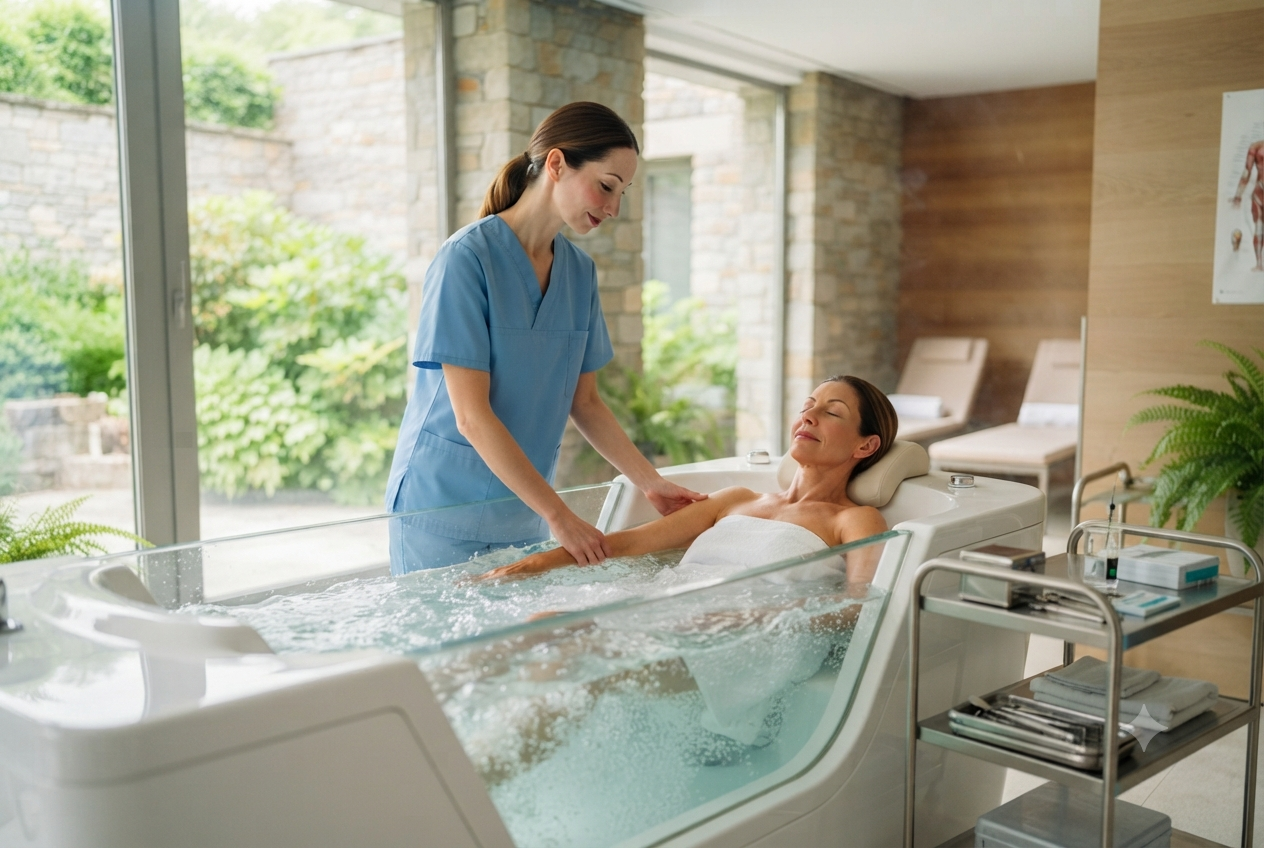
The CO₂ bath is drawn at 33–35 °C — body-warm, not hot. The temperature is critical: if the water is too warm, it stresses the cardiovascular system; if too cold, the CO₂ does not bubble effectively. The patient immerses up to the chest. Within seconds, the skin reddens — the first visible sign of capillary dilation. Blood pressure is often monitored during the first bath to confirm the vasodilation response.
The bath lasts 15–20 minutes. After the bath, a 20–30 minute rest period follows. The blood pressure reduction persists for four to six hours. In a dry CO₂ gas bath at Františkovy Lázně, the procedure is identical except the patient sits in a cabin with the head outside. CO₂ bath treatment — learn more about the full programme.
What to bring: the spa provides everything. You may wish to bring a book or magazine for the rest period after the bath. Blood pressure medication should be taken as prescribed — the spa doctor will advise on timing relative to the bath.
A Typical Spa Day with a CO₂ Bath
| Time | Activity |
|---|---|
| 07:00 | Rise — self-measure blood pressure |
| 07:30 | Drinking cure — as prescribed |
| 08:00 | Breakfast |
| 09:00 | CO₂ bath — 15–20 minutes, blood pressure monitored |
| 09:30 | Rest period — 20–30 minutes |
| 10:00 | Dosed walking — 1–2 km on flat terrain, pulse-monitored |
| 11:00 | Cardiac physiotherapy or relaxation therapy |
| 12:30 | Lunch |
| 14:00 | Massage or second rest period |
| 15:30 | Walking — spa park |
| 17:30 | Dinner |
| 19:00 | Evening walk — gentle, restorative |
Frequently Asked Questions
How quickly does a CO₂ bath lower blood pressure?
The vasodilation begins within seconds of immersion — the skin reddens visibly. Blood pressure drops measurably within five minutes. The effect lasts four to six hours after the bath. After a three-week course of 12–15 daily baths, baseline blood pressure is often lower than before the course — a cumulative effect beyond the acute vasodilation of each individual bath.
Is a stronger CO₂ concentration always better?
No — the concentration must match the patient’s cardiovascular status. Mariánské Lázně’s 2,500 mg/l CO₂ produces the strongest vasodilation and is ideal for stable hypertension and coronary disease. Teplice’s 375 mg/l produces a gentler effect — safer for patients with more compromised hearts. The spa doctor selects the appropriate spa and concentration.
Can CO₂ baths replace blood pressure medication?
No — they complement medication. Do not stop or reduce your medication without consulting your doctor. Many patients find that after a CO₂ bath course, their blood pressure is better controlled on the same medication dose — but any adjustment must be made by your physician at home.
Are CO₂ baths safe for elderly patients?
Yes — they are among the safest spa treatments for older patients. The bath temperature is body-warm (33–35 °C), so there is no heat stress. The CO₂ effect is purely physical — no drug interactions, no side effects. The bath is performed under medical supervision with blood pressure monitoring. Spa in the Czech Republic — discover all eight Czech spas.
Note: This information is for general guidance only and does not replace individual medical advice or diagnosis by a physician.

Author: Kuropa Editorial Team
Expert review: Anastasia Folak, Head of Spa Advisory
15+ years of experience in spa travel consulting
More about our expertise →