
🛡️ No Prepayment
Pay only on arrival
🚗 Door-to-Door Transfer
Directly to the hotel
🏥 Expert Care
English-speaking support
Key Facts
• Works on a system with no pump — the lymphatic network depends entirely on external stimulation
• Manual technique — gentle, rhythmic, circular movements moving lymph toward nodes
• Amplified in the spa context — warmth from preceding baths and packs dilates vessels, enhancing drainage
• Two forms — manual lymphatic drainage (therapist-applied) and pressotherapy (machine-applied)
• Available at most spa resorts — particularly integrated at Piešťany, Karlovy Vary, Budapest and Druskininkai
• German-speaking therapists at all recommended spa resorts
• No prepayment — pay at the hotel on arrival
Lymphatic Drainage at a Glance
| Feature | Details |
|---|---|
| Definition | Gentle, rhythmic manual massage technique that moves stagnant lymph fluid toward lymph nodes |
| Key Spas | Available at most resorts — particularly Piešťany, Karlovy Vary, Budapest, Druskininkai, Abano Terme, Mariánské Lázně |
| Duration per Session | 30–45 minutes |
| Frequency | Daily or every second day, 10–15 sessions per course |
| Amplified By | Preceding thermal bath, moor pack or fango — warmth dilates vessels, enhancing drainage |
| Kurdauer | 14–21 days recommended |
What Is Lymphatic Drainage?
The lymphatic system is the body’s secondary circulation — a network of vessels that collects excess fluid, metabolic waste and immune cells from the tissues and returns them to the bloodstream. Unlike the cardiovascular system, the lymphatic system has no central pump. Lymph moves only when external forces — muscle contractions, breathing movements, or manual therapy — push it along. The vessels contain one-way valves that prevent backflow, but the driving force must come from outside.
When the lymphatic system is overwhelmed — by surgery (lymph vessels are severed and need time to regenerate), by chronic inflammation (the fluid load exceeds drainage capacity), or by venous insufficiency (back-pressure from congested veins) — fluid accumulates in the tissues. The result is oedema (swelling), pain, heaviness, reduced mobility and impaired local immune function. The skin becomes vulnerable to infection because immune cells cannot circulate freely through the stagnant fluid.
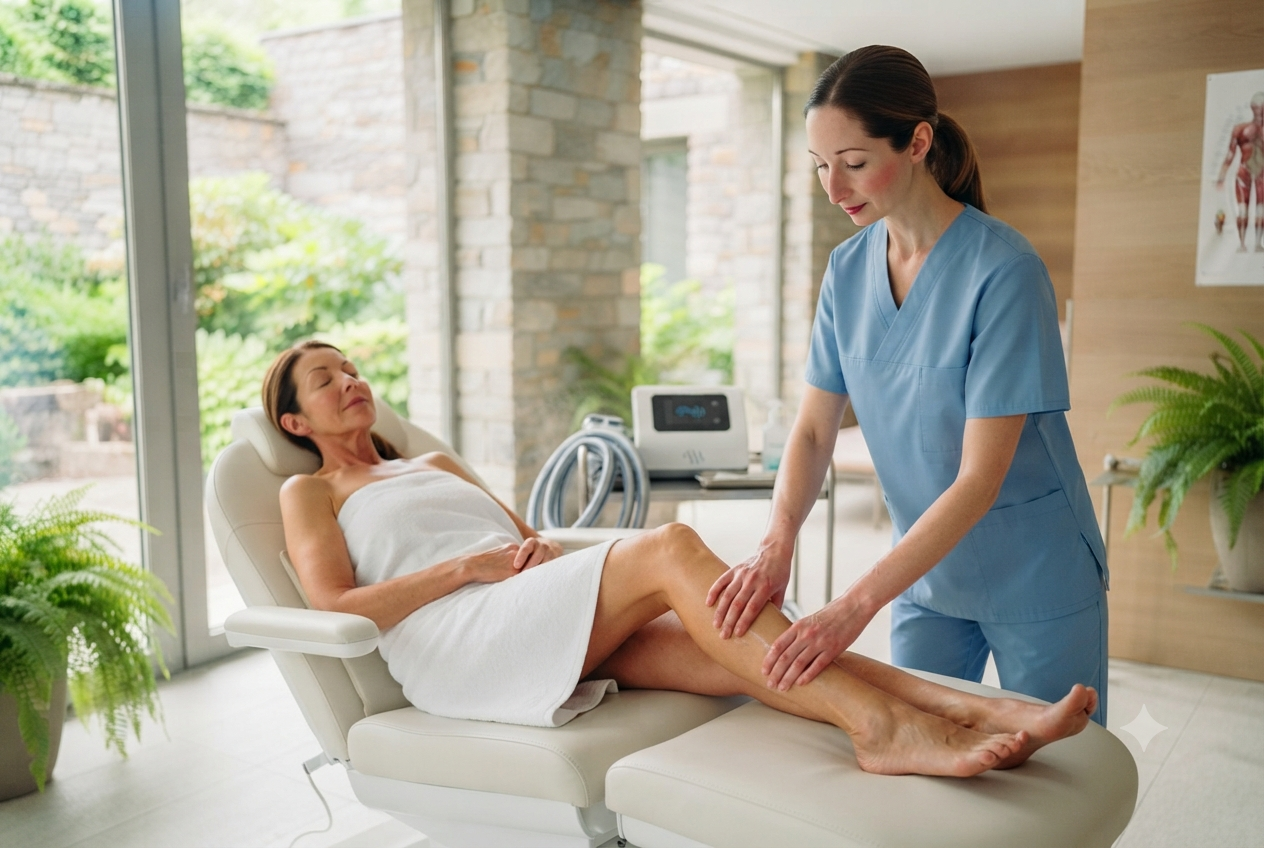
Manual lymphatic drainage is a precise technique developed in the 1930s by the Danish physiotherapist Emil Vodder. The therapist uses light, rhythmic, circular hand movements — never painful, never forceful — to stretch the skin in the direction of lymph flow. The pressure is gentle: heavy pressure would collapse the thin-walled lymph vessels. Each stroke moves fluid a few millimetres toward the nearest lymph node — a slow, cumulative process. A full session lasts 30–45 minutes and covers multiple body regions in sequence.
Pressotherapy — machine-assisted lymphatic drainage — uses an inflatable garment (sleeve, boot or vest) that applies sequential pneumatic compression. The machine inflates chambers from distal to proximal, mimicking the natural direction of lymph flow. Pressotherapy is used when manual drainage alone is insufficient or for patients who require daily drainage over large body areas.
In the spa context, lymphatic drainage is rarely performed in isolation. It is typically preceded by a thermal bath or moor pack — the heat dilates peripheral vessels and relaxes tissues, making the lymph vessels more responsive to the drainage technique. The combination of passive heat therapy followed by active drainage produces a decongestant effect that neither treatment alone can achieve.
Who Can Benefit from Lymphatic Drainage?
| Condition | Mechanism | Recommended Spa |
|---|---|---|
| Post-Surgery Oedema | Lymph vessels severed during surgery need weeks to regenerate — drainage removes accumulated fluid | Piešťany, Abano Terme |
| Lymphedema (Primary) | Congenital lymphatic insufficiency — regular drainage maintains limb volume | Karlovy Vary, Budapest |
| Chronic Venous Insufficiency | Venous back-pressure overloads lymphatics — drainage decongests tissues | Mariánské Lázně, Budapest |
| Post-Mastectomy | Axillary lymph node removal blocks arm drainage — manual drainage redirects lymph to alternative pathways | Karlovy Vary, Piešťany |
| Rheumatoid Arthritis | Inflammatory fluid accumulates around joints — drainage reduces swelling and pain | Piešťany, Jáchymov |
| Fibromyalgia | Lymphatic stagnation contributes to soft-tissue pain — drainage improves tissue fluid dynamics | Świeradów-Zdrój, Druskininkai |
| Sports Recovery | Intense training temporarily overloads lymphatics — drainage accelerates recovery | Abano Terme, Budapest |
Not suitable for: acute infections (risk of spreading bacteria via lymphatics), acute deep vein thrombosis, decompensated heart failure, and active malignancy in the drainage area. The spa doctor determines individual suitability.
A Typical Spa Day with Lymphatic Drainage
| Time | Activity |
|---|---|
| 07:00 | Rise — a glass of water (hydration supports lymph flow) |
| 08:00 | Breakfast |
| 09:00 | Thermal bath or moor pack — 20 minutes (dilates vessels, prepares tissues) |
| 10:00 | Lymphatic drainage — 30–45 minutes, manual or pressotherapy |
| 11:00 | Rest period — 20 minutes (lymph continues to flow after treatment) |
| 12:30 | Lunch |
| 14:00 | Light walk — muscle contraction supports lymph flow |
| 15:00 | Massage or second therapy session |
| 17:30 | Dinner |
| 19:00 | Evening walk — gentle, restorative |
Frequently Asked Questions
Is lymphatic drainage painful?
No — it is one of the gentlest manual therapies. The pressure is light and rhythmic. Patients often describe the sensation as deeply relaxing — a gentle, flowing touch that leaves the treated area feeling lighter and less congested. If drainage is painful, the therapist is applying too much pressure.
How many sessions do I need?
The standard spa course is 10–15 sessions over two to three weeks. For post-surgical oedema, daily sessions in the first week produce the most dramatic reduction in swelling. For chronic conditions like lymphedema, maintenance sessions every second day sustain the improvement.
Can lymphatic drainage help with weight loss or cellulite?
Lymphatic drainage is not a weight-loss or cosmetic treatment. It removes excess fluid from tissues — this can temporarily reduce volume in fluid-retentive areas, but it does not break down fat cells or cellulite. The medical indication is oedema and lymphatic insufficiency, not aesthetic concerns.
Do I need to prepare for a lymphatic drainage session?
Drink a glass of water before the session — hydration supports lymph flow. Avoid heavy meals immediately beforehand. The spa programme typically schedules drainage after a thermal bath or moor pack — this sequence is deliberate and should be followed. Physiotherapy treatment — learn about the full rehabilitation programme.
Note: This information is for general guidance only and does not replace individual medical advice or diagnosis by a physician.

Author: Kuropa Editorial Team
Expert review: Anastasia Folak, Head of Spa Advisory
15+ years of experience in spa travel consulting
More about our expertise →