
🛡️ No Prepayment
Pay only on arrival
🚗 Door-to-Door Transfer
Directly to the hotel
🏥 Expert Care
English-speaking support
Key Facts
– Founded 1818 — youngest of the Triangle spas, UNESCO Great Spa of Europe since 2021 – 40 cold mineral springs — 7–10 °C, CO₂ up to 2,500 mg/l, iron, calcium – 100-hectare spa park — largest in the Czech Republic – World leader for kidney and urinary tract treatment ★★★ – CO₂ baths — natural vasodilation, blood pressure reduction without medication – German-speaking doctors and therapists in all spa hotels – No prepayment — pay at the hotel on arrival
Mariánské Lázně at a Glance
| Feature | Details |
|---|---|
| Founded | 1818 by the Teplá Monastery |
| Springs | 40 cold springs, 7–10 °C, CO₂ up to 2,500 mg/l |
| Strongest Spring | Cross Spring (Křížový pramen) — 9.8 g/l, CO₂ 2,500 mg/l |
| Specialisation | Kidneys ★★★, Urinary Tract, Respiratory, Hypertension |
| Spa Park | 100 hectares — largest in the Czech Republic |
| Signature Structure | Main Colonnade — cast-iron, 119 m, built 1889 |
| Kurdauer | 14–21 days recommended |
What Does Mariánské Lázně Treat?
Mariánské Lázně is the world’s leading spa for kidney and urinary tract diseases — a specialisation based on the unique mechanism of CO₂-rich cold water that no other spa replicates at this concentration.
– Kidney stones — CO₂ increases diuresis, regulates urinary pH, flushes the urinary tract intensively (★★★) – Chronic urinary tract infections — increased urine flow and pH regulation create an environment hostile to bacteria – Hypertension — CO₂ baths dilate capillaries, measurably lowering blood pressure within minutes (★★★) – Chronic bronchitis — the cool, crisp mountain air at 630 m combined with inhalation therapy – COPD — inhalation with mineral water reaches deep bronchial branches – Chronic gastritis — cold CO₂ water stimulates gastric secretion and improves digestion – Osteoporosis — calcium-rich water plus daily walking in the 100-hectare park – Post-operative rehabilitation — gentle CO₂ baths and walking therapy
The Springs of Mariánské Lázně
| Spring | Location | Temperature | CO₂ | Note |
|---|---|---|---|---|
| Cross Spring (Křížový) | Main Colonnade | 8 °C | 2,500 mg/l | Strongest — 9.8 g/l, for digestive and kidney treatment |
| Ferdinand Spring | Main Colonnade | 9 °C | 2,000 mg/l | Most popular drinking spring |
| Forest Spring (Lesní) | Forest Spring Pavilion | 7 °C | 1,800 mg/l | For respiratory inhalation |
| Rudolph Spring | Rudolph Spring Pavilion | 10 °C | 1,500 mg/l | Mildest — for first-time drinkers |
| Ambrose Spring | Ambrosius Spring Pavilion | 8 °C | 2,200 mg/l | Iron-rich, for anaemia |
Treatments in Mariánské Lázně
drinking cure: The water is drunk cold — 7–10 °C — so the dissolved CO₂ remains bound in the water. When it reaches the stomach, the CO₂ is released, stimulating gastric acid secretion and, crucially, acting as a powerful diuretic. The kidneys are flushed intensively — urine output increases measurably within 30 minutes. The prescription follows the standard formula: 3 ml per kg body weight, 2–3 times daily before meals. The Cross Spring, with 9.8 g/l mineralisation and 2,500 mg/l CO₂, is the strongest and most commonly prescribed. mineral water therapy — learn more.
CO₂ bath: The high natural CO₂ content makes mariánské lázně co₂ baths particularly intensive. The water is used at 33–34 °C — cool enough not to stress the cardiovascular system, warm enough to keep the CO₂ bubbling on the skin. The gas forms tiny pearls that expand capillaries by up to 300 percent. Blood pressure drops measurably within five minutes — a natural vasodilation without pharmaceutical side effects. The bath lasts 15–20 minutes and is prescribed daily for hypertension patients.
inhalation: The Forest Spring water is nebulised into micro-droplets and inhaled through a mouthpiece for 10–15 minutes. The mineral-rich aerosol reaches the finest bronchial branches, liquefying mucus and reducing inflammation. Mariánské Lázně has a modern inhalatorium — one of the largest in Czech spa medicine. Inhalation treatment — learn more.
Moor pack: Peat moor from the surrounding Slavkov Forest is heated to 38–42 °C and applied as a full-body or partial pack. The humic acids and organic compounds penetrate deep into tissue — particularly effective for gynaecological conditions and arthrosis. The moor packs at Mariánské Lázně are gentler than the sulfur mud of Piešťany or the hot fango of Abano Terme, making them suitable for patients who cannot tolerate more intensive heat therapy.
History and Atmosphere
Mariánské Lázně is the product of a clear vision. The Teplá Monastery owned the land and, in the early 19th century, commissioned the systematic development of a spa town around the cold mineral springs that had been known locally for centuries. The monastery’s abbot, Karel Kašpar Reitenberger, is considered the founder — he saw the potential of the CO₂-rich waters and invested monastic funds in the first spa buildings.
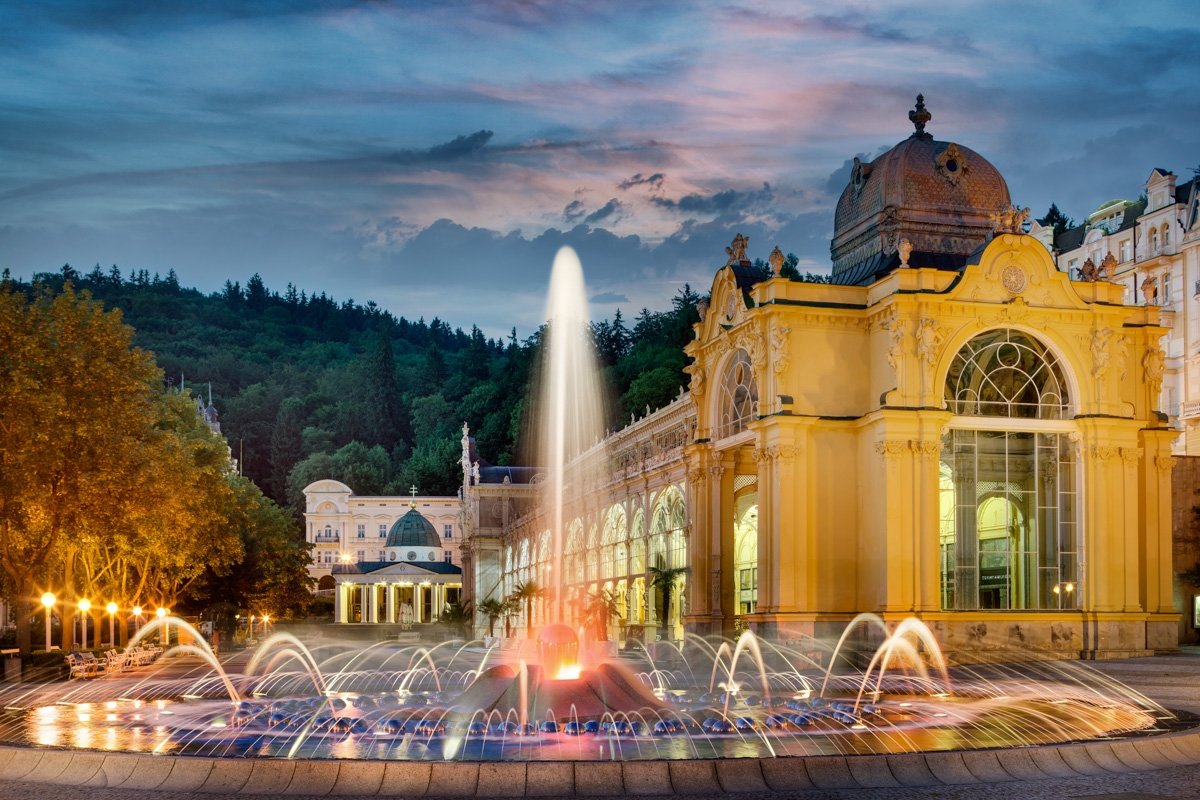
The result was a planned spa town of unusual elegance. The landscape architect Václav Skalník designed a 100-hectare park on what had been marshland — wide boulevards, formal gardens, and specimen trees that thrive in the cool mountain microclimate. The neoclassical and Empire-style spa buildings were placed with deliberate symmetry. The Main Colonnade — a 119-metre cast-iron filigree structure painted sky blue, built in 1889 — is perhaps the most photogenic colonnade in Central Europe.
The guest list is a register of 19th-century European culture. Johann Wolfgang von Goethe visited repeatedly — his final stay in 1823, at the age of 74, inspired the famous “Marienbad Elegy” after he fell in love with the 19-year-old Ulrike von Levetzow. King Edward VII of England was a regular visitor and patron. Frédéric Chopin gave a concert here in 1836. Franz Joseph I, Emperor of Austria, was a frequent guest.
Today, Mariánské Lázně is quieter and more refined than Karlovy Vary — fewer tourists, more parkland, a cooler climate. The Singing Fountain, built in 1986 — one of the first computer-controlled musical fountains in Europe — performs to Chopin, Mozart and Dvořák every odd hour during the season. For guests who want effective spa treatment in an atmosphere of calm elegance, surrounded by forest and park, Mariánské Lázně is the better choice.
Attractions Near Mariánské Lázně
– 🎵 Main Colonnade — 119 m cast-iron filigree from 1889, sky-blue, the icon of the spa – ⛲ Singing Fountain — computer-controlled musical fountain, Chopin and Mozart every odd hour – 🌿 100-Hectare Spa Park — largest in the Czech Republic, Skalník’s landscape masterpiece – ⛪ Church of the Assumption — Empire-style church with columned portico, completed 1820 – 🏛 Teplá Monastery — Premonstratensian abbey from 1193, 15 km, with world-famous library – 🏰 Prelature — oldest surviving building, 17th-century Teplá Abbey estate
Getting to Mariánské Lázně from Germany
Mariánské Lázně lies in the West Bohemian Spa Triangle, even closer to the German border than Karlovy Vary. From Nuremberg it is 150 kilometres (1 hour 45 minutes), from Dresden 210 kilometres (2 hours 30 minutes). The resort has its own railway station with direct connections from Cheb (Eger), which is on the main line from Nuremberg. The door-to-door transfer collects you from your home address — with German-speaking driver. Karlovy Vary International Airport is 50 kilometres away.
A Typical Spa Day in Mariánské Lázně
| Time | Activity |
|---|---|
| 06:30 | Rise — walk to the Main Colonnade |
| 07:00 | First drinking cure — cold water at the Cross Spring |
| 07:30 | Rest period — 20 minutes in the colonnade |
| 08:00 | Breakfast |
| 09:00 | CO₂ bath — 20 minutes, natural vasodilation |
| 10:00 | Walk in the 100-hectare spa park — 45–60 minutes |
| 12:00 | Second drinking cure — before lunch |
| 12:30 | Lunch |
| 14:00 | Moor pack or inhalation — 15–20 minutes |
| 16:00 | Third drinking cure — afternoon |
| 17:30 | Dinner |
| 19:00 | Evening walk — Singing Fountain performance |
Frequently Asked Questions
Why is the water drunk cold in Mariánské Lázně?
Unlike Karlovy Vary where the heat of the water is therapeutic, Mariánské Lázně’s water must be drunk cold — otherwise the dissolved CO₂ escapes before reaching the stomach. The CO₂ release in the stomach is the key therapeutic mechanism: it stimulates gastric secretion and, critically, acts as a powerful diuretic. If the water is warmed, you lose the CO₂ and with it most of the therapeutic effect.
Which spa is better for kidneys — Mariánské Lázně or Karlovy Vary?
Mariánské Lázně by a large margin. The CO₂-driven diuresis — increased urine production — is unique to CO₂-rich cold water. Karlovy Vary’s hot water works on the digestive tract, not the kidneys. For kidney stones, chronic urinary tract infections or hypertension, Mariánské Lázně is the first choice.
Is Mariánské Lázně suitable for older guests?
Excellent — the spa park and colonnades are completely flat, with no hills or stairs in the treatment area. The cool climate at 630 metres is refreshing in summer without being cold. The CO₂ baths at 33–34 °C do not stress the cardiovascular system — safer for older patients than hot thermal baths.
Can I combine Mariánské Lázně with Karlovy Vary?
Ideally — the two resorts are only 40 kilometres apart. A classic combination: one week Mariánské Lázně for kidneys and blood pressure, one week Karlovy Vary for digestion and metabolism. Compare Czech spas — see all comparisons.
Note: This information is for general guidance only and does not replace individual medical advice or diagnosis by a physician.

Author: Kuropa Editorial Team
Expert review: Anastasia Folak, Head of Spa Advisory
15+ years of experience in spa travel consulting
More about our expertise →