
🛡️ No Prepayment
Pay only on arrival
🚗 Door-to-Door Transfer
Directly to the hotel
🏥 Expert Care
English-speaking support
Key Facts
– 3 spa resorts — Druskininkai (multidisciplinary), Birštonas (intimate), Palanga (Baltic amber) – Europe’s most mineralised healing water — Surutis spring, Druskininkai, 52.5 g/l – Broadest treatment spectrum in Europe — Druskininkai treats 8 medical categories – Unique amber therapy — Palanga, succinic acid from Baltic amber, found nowhere else – Nemunas River — one of Europe’s largest rivers, borders both inland resorts – German-speaking doctors and medical staff in all spa hotels – No prepayment — pay at the hotel, book your Lithuania cure without risk
Lithuania at a Glance
| Feature | Details |
|---|---|
| Spas | 3 (Druskininkai, Birštonas, Palanga) |
| Healing Factors | Mineral springs (Na-Cl-Ca), Baltic Sea climate, amber succinic acid, peat moor, pine forest air |
| Highest Mineralisation | Druskininkai Surutis — 52.5 g/l (world record) |
| Broadest Spectrum | Druskininkai — 8 treatment categories |
| Unique Therapy | Palanga amber therapy — succinic acid (C₄H₆O₄) |
| Kurdauer | 14–21 days recommended |
Spa Resorts in Lithuania
Druskininkai — the largest spa resort in the Baltic states and the only one in Europe treating eight medical categories simultaneously. The Surutis spring delivers water with a mineralisation of 52.5 grams per litre — nearly eight times that of Karlovy Vary. The water is too strong to drink undiluted; it is precisely dosed at 4–6 g/l and prescribed individually for each condition. The treatment spectrum spans digestion, musculoskeletal, respiratory, cardiovascular, dermatology, gynaecology, neurology and endocrinology — a patient with diabetes, arthrosis and hypertension can have all three conditions treated in a single resort, under a single medical team, with a single coordinated treatment plan. No other European spa offers this breadth.
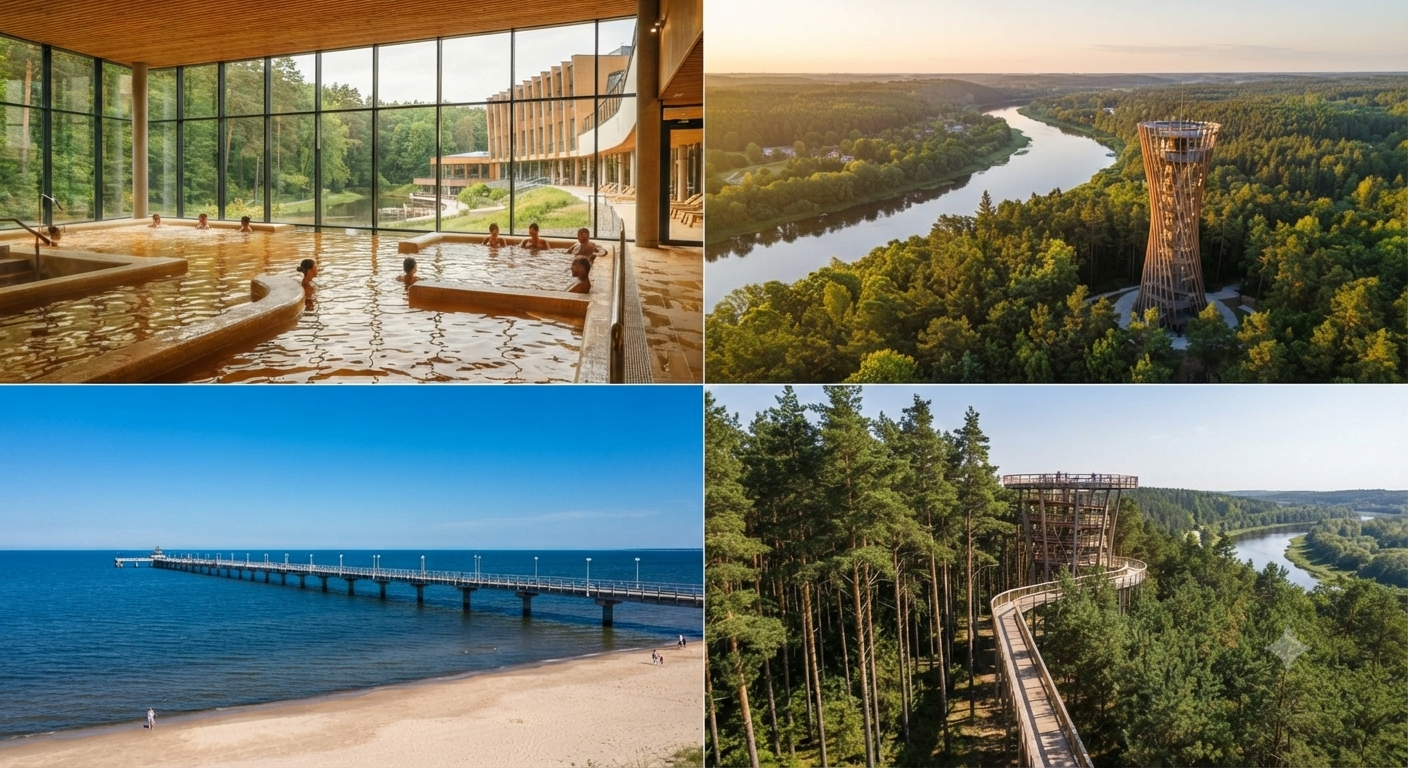
The resort is embedded in a pine forest along the Nemunas River. The air is exceptionally clean — pine terpenes and low allergen loads support respiratory therapy and general recovery. Eight mineral springs, a modern rehabilitation centre, and ten spa hotels make Druskininkai the best spa for multiple simultaneous conditions — the ultimate medical spa for patients with complex diagnoses.
Birštonas — the intimate alternative. Located 50 kilometres from Druskininkai in a dramatic bend of the Nemunas River — one of the largest river meanders in Europe — Birštonas uses the same sodium-chloride-calcium water at a gentler concentration of 8–12 g/l. The resort has only five spa hotels, no large rehabilitation centre, and a fraction of the guest numbers of Druskininkai. The Vaidilutė spring is ideal for digestive disorders and metabolic conditions in patients who find the highly mineralised Druskininkai water too strong. The atmosphere is that of a private spa retreat: forests come down to the river, the silence is broken only by the Nemunas current, and the pace is deliberately slow. For a first spa cure experience or for patients seeking absolute quiet, Birštonas is the better choice.
Palanga — the Baltic amber spa. Palanga is a Baltic seaside resort with 24 kilometres of fine sand and a 470-metre pier — one of the longest in northern Europe — that serves as a natural inhalation platform over the sea. But Palanga adds something no other seaside spa has: amber therapy. Baltic amber — fossilised pine resin from 40-million-year-old forests — contains succinic acid (C₄H₆O₄), a compound that stimulates mitochondrial energy production in cells. In the amber sauna, amber is heated to 50–60 °C, releasing succinic acid as a fine vapour that is absorbed through the skin and respiratory tract. Amber salves are applied directly to affected skin. The therapy is clinically documented for psoriasis, neurodermitis and inflammatory skin conditions — and it is available nowhere else in the world.
The iodine-bromine brine from Palanga’s own spring, the Baltic thalassotherapy programme, and the lithuanian peat moor packs complete the treatment spectrum — making Palanga the best spa for dermatology and respiratory care on the eastern Baltic.
Spa Resorts Compared
| Spa | Healing Factor | Speciality |
|---|---|---|
| Druskininkai ★★★ | Surutis 52.5 g/l, Na-Cl-Ca, 8 springs | Multidisciplinary — 8 categories, Digestion ★★★ |
| Birštonas ★★ | Vaidilutė 10–12 g/l, Na-Cl-Ca, 3 springs | Digestion ★★, Metabolism, Intimate Atmosphere |
| Palanga ★★ | Baltic Sea, amber succinic acid, iodine-bromine brine | Dermatology ★★★, Respiratory ★★★, Gynaecology |
Treatments in Lithuania
Drinking cure with Surutis water: The Surutis spring at Druskininkai with 52.5 g/l is the most mineralised healing water in Europe — so concentrated it must be diluted to 4–6 g/l for drinking. The high sodium-chloride concentration acts powerfully on the digestive tract, stimulating liver and gall bladder function. The prescription follows the standard formula: 3 ml per kg body weight, drunk on an empty stomach in the morning and before meals. Drinking cure treatment — learn more.
Mineral baths: At Druskininkai and Birštonas, the sodium-chloride-calcium water is heated to 37–40 °C for full baths. The minerals are absorbed transdermally, relaxing skeletal muscles and improving peripheral circulation. The low-to-moderate mineralisation at Birštonas (8–12 g/l) is gentler on sensitive skin.
Amber therapy: Unique to Palanga. In the amber sauna, raw Baltic amber is heated, releasing succinic acid vapour. The vapour is absorbed through the skin and lungs, where it stimulates cellular energy production in the mitochondria. Amber salves — succinic acid dissolved in oil — are applied to psoriatic plaques and neurodermitis lesions. The therapy is administered daily or every second day, complementing the brine baths and Baltic thalassotherapy.
Peat moor packs: Lithuanian high-moor peat — rich in humic acids — is heated to 40–42 °C and applied as full-body or partial packs. The packs are particularly effective for gynaecological conditions and arthrosis. All three resorts offer this treatment.
History and Spa Tradition
Druskininkai derives its name from the Lithuanian word druska — salt — and its springs were known as early as the 16th century. The systematic spa operation began in 1837 under Russian Tsarist rule, when Druskininkai became the resort of the Polish-Lithuanian nobility. The neoclassical and Art Nouveau spa buildings date from this era. After Soviet annexation in 1940, Druskininkai was developed as a sanatorium for the Soviet elite — the large rehabilitation centre and multi-category treatment model are legacies of that period, refined and modernised since independence in 1991.
Birštonas has a quieter history. It was the hunting ground of the Lithuanian Grand Dukes in the 14th century, mentioned in the chronicles of the Teutonic Order. The healing springs were discovered in the 18th century, and the spa developed alongside Druskininkai in the 19th century — but Birštonas deliberately remained smaller and more exclusive.
Palanga’s amber tradition reaches back to the Amber Road, the prehistoric trade route that carried Baltic amber to the Mediterranean. The Tiškevičius Palace, built in 1897 by Count Józef Tyszkiewicz in Neo-Renaissance style, now houses the Amber Museum — one of the world’s largest collections — set in a botanical garden with exotic plants from around the globe. Palanga became a spa destination in the 19th century for the Russian and Polish aristocracy, and the 470-metre pier — rebuilt after a storm in 1998 — remains its architectural and therapeutic centrepiece.
Typical Spa Day in Lithuania (Druskininkai)
| Time | Activity |
|---|---|
| 07:00 | Rise — drinking cure with Surutis water |
| 08:00 | Breakfast |
| 09:00 | Mineral bath — 20 minutes |
| 10:00 | Physiotherapy or medical exercise |
| 11:00 | Walk in the pine forest — 45 minutes |
| 12:30 | Lunch |
| 14:00 | Peat moor pack — 20 minutes |
| 15:00 | Massage or electrotherapy |
| 16:30 | Inhalation — 15 minutes |
| 17:30 | Dinner |
| 19:00 | Evening walk along the Nemunas River |
Frequently Asked Questions
Why eight treatment categories in one resort?
Druskininkai has the Surutis spring at 52.5 g/l and seven other springs with different mineral profiles — enough diversity to prepare individually dosed water for each condition. Most spas have one or two water types and specialise accordingly. For patients with multiple conditions — a diabetic with arthrosis and hypertension — Druskininkai can treat all three under one roof, eliminating the need to visit multiple resorts.
What is amber therapy and does it really work?
Succinic acid from Baltic amber stimulates mitochondrial energy production. In Palanga, heating amber releases the acid as a vapour that is absorbed through the skin and lungs. Clinical studies — primarily Lithuanian and Polish — document measurable improvement in psoriatic plaques and neurodermitis lesions. The therapy is complementary to brine baths and Baltic climate, not a standalone cure.
Is the long journey to Lithuania worthwhile?
For patients with multiple conditions who cannot be fully treated at a single-disease specialist spa, Druskininkai is a solution that exists nowhere else in Europe. Direct flights to Vilnius from German airports take about two hours, and the transfer from Vilnius to Druskininkai or Birštonas is 90 minutes. Palanga has its own international airport with seasonal direct connections.
Are German-speaking doctors available in Lithuania?
The German-speaking care is less comprehensive than in Czech or Polish spas, but the international spa hotels at Druskininkai and Palanga have English-speaking and some German-speaking doctors. The German-speaking care standard is well established at the larger resorts. Compare Lithuanian spas — see all comparisons.
Note: This information is for general guidance only and does not replace individual medical advice or diagnosis by a physician.
Author: Kuropa Editorial Team
Expert review: Anastasia Folak, Head of Spa Advisory
15+ years of experience in spa travel consulting
More about our expertise →