
🛡️ No Prepayment
Pay only on arrival
🚗 Door-to-Door Transfer
Directly to the hotel
🏥 Expert Care
English-speaking support
Key Facts
– 8 spa resorts — Karlovy Vary, Mariánské Lázně, Františkovy Lázně, Teplice, Jáchymov, Poděbrady, Konstantinovy Lázně, Luhačovice – Three UNESCO Great Spas of Europe since 2021 — Karlovy Vary, Mariánské Lázně, Františkovy Lázně – 650 years of drinking cure — documented since 1358 in Karlovy Vary – Over 200 mineral springs — temperatures from 7 °C to 73 °C – Healing factors ★★★ — hyperthermal sodium-bicarbonate-sulphate water, CO₂-rich cold springs, Glauber-salt water, iron-rich peat moor, radon water, iodine-rich Vincentka water – Treatment spectrum — digestion, diabetes, gout, metabolism; kidneys, urinary tract, respiratory; cardiovascular; musculoskeletal, rheumatology; gynaecology, infertility – German-speaking care in all eight spa resorts — doctors, therapists, and hotel staff – No prepayment — pay at the hotel on arrival, book your spa resort stay without risk
Czech Republic at a Glance
| Feature | Details |
|---|---|
| Spas | 8 (Karlovy Vary, Mariánské Lázně, Františkovy Lázně, Teplice, Jáchymov, Poděbrady, Konstantinovy Lázně, Luhačovice) |
| UNESCO | 3 Great Spas of Europe (2021) |
| Springs | 200+, 7–73 °C |
| Strongest Water | Františkovy Lázně Glauberquelle — 23 g/l |
| Hottest Spring | Karlovy Vary Vřídlo — 73 °C |
| Highest CO₂ | Mariánské Lázně — up to 2,500 mg/l |
| Kurdauer | 14–21 days recommended |
Spa Resorts in the Czech Republic
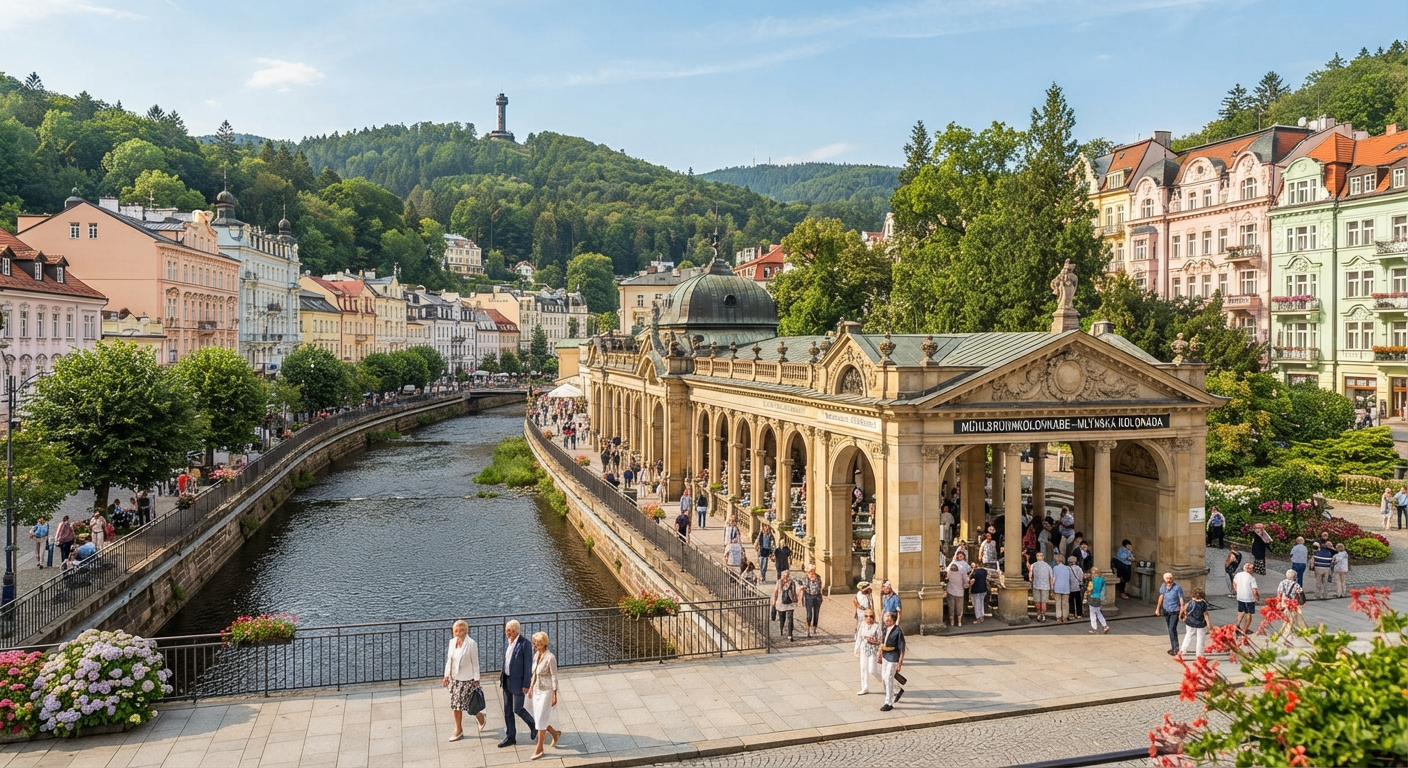
Karlovy Vary (Carlsbad) — founded 1370 by Emperor Charles IV, is the largest and most traditional Czech spa. Its 13 hyperthermal springs at 30–73 °C produce sodium-bicarbonate-sulphate water with 6.8 g/l total mineralisation. The water is drunk hot — the temperature relaxes the smooth muscles of the stomach and gall bladder, stimulates the pancreas, and improves insulin action. Karlovy Vary is the global leader for digestion, diabetes, gout and metabolism — the best spa for diabetes and digestive disorders in Europe. Over 50 spa hotels from 3★ to 5★ including the legendary Grandhotel Pupp.
Mariánské Lázně (Marienbad) — founded 1818, features 40 cold CO₂-rich springs at 7–10 °C with CO₂ content up to 2,500 mg/l — the highest of any Czech spa. The water is drunk cold to keep the dissolved CO₂ bound; upon drinking, CO₂ releases in the stomach, stimulates gastric secretion, and acts as a powerful diuretic. Mariánské Lázně is the best spa for kidney and respiratory treatment — Europe’s premier address for kidney stones, urinary tract infections, chronic bronchitis and hypertension. The 100-hectare spa park is the largest in the country.
Františkovy Lázně (Franzensbad) — founded 1793 by Emperor Franz II, has 24 springs including Europe’s strongest Glauber-salt water at 23 g/l. Combined with unique iron-rich peat moor from centuries-old forest bogs, Františkovy Lázně is the leading gynaecology spa in Europe — particularly for infertility, chronic pelvic inflammation and cycle disorders. Goethe stayed here 19 times.
Teplice — the oldest Czech spa, legend dates it to 762 AD, with 15 thermal springs at 30–44 °C. The pearl bath was invented here — fine CO₂ bubbles providing intensive micro-massage. Teplice is the best spa for cardiovascular rehabilitation in northern Bohemia. Beethoven composed parts of his 7th Symphony here in 1811–1812.
jáchymov — the world’s first radon spa since 1906. Radon-containing thermal water from former uranium mines at 36–38 °C and 1–3 kBq/l activates the body’s own anti-inflammatory enzymes. Jáchymov is the premier European address for rheumatoid arthritis and Bechterew’s disease. Marie Curie isolated radium from Jáchymov pitchblende in 1898.
poděbrady — founded 1908 as a modern cardiology centre, with 13 alkaline hydrogen-carbonate springs along the Elbe River. The completely flat terrain provides ideal conditions for dosed walking training. Poděbrady is the best spa for post-heart attack rehabilitation in Central Europe.
konstantinovy lázně — the smallest spa of the Triangle, with three CO₂-rich springs in a forested setting at 520 m altitude. An intimate cardiovascular spa for guests seeking personal care and absolute quiet — only three spa hotels, no crowds.
Luhačovice — the largest Moravian spa, famous for its Vincentka mineral water — iodine-rich, alkaline and unique in Europe. Luhačovice is the best spa for respiratory treatment including COPD, asthma and chronic bronchitis. The Art Nouveau architecture by Dušan Jurkovič is among the most beautiful in any European spa resort.
Spa Resorts Compared
| Spa | Springs | Temperature | Speciality |
|---|---|---|---|
| Karlovy Vary ★★★ | 13 (Na-HCO₃-SO₄, 6.8 g/l) | 30–73 °C | Digestion, Diabetes, Gout, Metabolism |
| Mariánské Lázně ★★★ | 40 (CO₂ up to 2,500 mg/l) | 7–10 °C | Kidneys, Urinary, Respiratory, Hypertension |
| Františkovy Lázně ★★★ | 24 (Glauber salt 23 g/l, iron) | 8–12 °C | Gynaecology, Infertility, Cardiovascular |
| Teplice | 15 (Na-HCO₃, fluoride) | 30–44 °C | Cardiovascular, Musculoskeletal |
| Jáchymov | Radon water 1–3 kBq/l | 36–38 °C | Rheumatoid Arthritis, Bechterew |
| Poděbrady | 13 (alkaline, CO₂) | 12–14 °C | Post-Heart Attack, Hypertension |
| Konstantinovy Lázně | 3 (CO₂-rich) | 8–10 °C | Cardiovascular, Hypertension |
| Luhačovice | 10 (Vincentka, iodine) | 10–12 °C | Respiratory, COPD, Asthma |
Treatments in the Czech Republic
Drinking cure: The signature treatment of Czech spa culture. Hot thermal water in Karlovy Vary relaxes stomach and gall bladder muscles — the best natural cure for digestion problems. Cold CO₂-rich water in Mariánské Lázně stimulates gastric secretion and acts as a powerful diuretic — the most effective natural treatment for kidney stones. Glauber-salt water in Františkovy Lázně works osmotically, drawing water into the bowel — unmatched for chronic constipation. The prescription is individual: which spring, how much (3 ml per kg body weight), at what temperature and time of day. Mineral water therapy — learn more about the drinking cure.
CO₂ bath: The high natural CO₂ content of Mariánské Lázně and Poděbrady water makes CO₂ baths particularly intensive. The carbon dioxide bubbles form on the skin, expanding capillaries by up to 300 percent, measurably lowering blood pressure within minutes — CO₂ bath therapy without medication or heat stress. Karlovy Vary, Mariánské Lázně, Poděbrady and Konstantinovy Lázně all offer this treatment.
Moor and peat packs: Františkovy Lázně’s iron-rich forest moor applied at 42 °C is unique for gynaecological conditions — natural oestrogen-like compounds penetrate deep into pelvic tissue. Mariánské Lázně forest moor at 38–42 °C treats musculoskeletal conditions. Karlovy Vary specialises in Parafango — a combination of moor and paraffin wax.
Radon therapy: Exclusive to Jáchymov. The radon concentration of 1–3 kBq/l is extremely low — comparable to a long-haul flight — yet the alpha radiation activates superoxide dismutase and catalase, enzymes that neutralise free radicals overproduced during chronic inflammation. The effect on rheumatoid arthritis lasts six to twelve months after a single three-week course.
Inhalation and pearl baths: Luhačovice Vincentka inhalation reaches the finest bronchial branches — the best natural inhalation cure for COPD. Teplice pearl baths provide CO₂ micro-massage that dilates blood vessels and lowers blood pressure.
History and Spa Tradition
The Czech spa tradition is the oldest continuous medical bathing culture in continental Europe. Karlovy Vary was founded in 1370 by Emperor Charles IV, who discovered the first hot spring while hunting. By the 16th century, the drinking cure was codified — the first medical prescription for mineral water was written in 1521 by the physician Václav Payer.
The 19th century was the golden age. Goethe visited Karlovy Vary, Mariánské Lázně and Františkovy Lázně repeatedly — his 1823 stay in Mariánské Lázně inspired the famous “Marienbad Elegy”. Beethoven composed parts of his 7th Symphony in Teplice in 1811–1812. Chopin played a concert in Mariánské Lázně in 1836. Casanova spent his final years as librarian at Duchcov Castle near Teplice. Marie Curie isolated radium from Jáchymov pitchblende in 1898, winning the Nobel Prize — and creating the scientific foundation for radon therapy.
In 2021, Karlovy Vary, Mariánské Lázně and Františkovy Lázně were inscribed as UNESCO Great Spas of Europe — confirming the Czech spa cure as world heritage. Today, the Czech Republic offers the densest concentration of specialised mineral-water medical spas in the world, all within a compact 100-kilometre rectangle in West Bohemia — a spa destination without equal.
Typical Spa Day in the Czech Republic
| Time | Activity |
|---|---|
| 06:30 | Rise — walk to the colonnade |
| 07:00 | First drinking cure — 200–250 ml at the spring |
| 07:30 | Rest period — 20 minutes sitting or slow walking |
| 08:00 | Breakfast in the spa hotel |
| 09:00 | CO₂ bath or thermal bath — 20 minutes |
| 10:00 | Walk in the spa park — 45–60 minutes |
| 12:00 | Second drinking cure — before lunch |
| 12:30 | Lunch — spa-compatible diet |
| 14:00 | Moor pack, massage or physiotherapy |
| 16:00 | Third drinking cure — afternoon |
| 17:30 | Dinner |
| 19:00 | Evening walk — colonnade concert or park promenade |
Frequently Asked Questions
Which Czech spa is right for me?
Karlovy Vary if you have digestive problems, diabetes or gout. Mariánské Lázně for kidneys, urinary tract or respiratory conditions. Františkovy Lázně for gynaecological problems or infertility. Jáchymov for rheumatoid arthritis or Bechterew’s disease. Teplice or Poděbrady for cardiovascular rehabilitation. Luhačovice for respiratory diseases including COPD and asthma. Compare Czech spas — see all spa comparisons.
Can I combine multiple Czech spas in one stay?
Yes — the West Bohemian Spa Triangle is a compact rectangle of roughly 100 by 50 kilometres. Karlovy Vary and Mariánské Lázně are only 40 kilometres apart. A combination of one week Karlovy Vary for digestion plus one week Mariánské Lázně for kidneys is a classic two-week cure. Františkovy Lázně is 30 kilometres from Karlovy Vary.
Are German-speaking doctors available?
Yes — Czech spa doctors have spoken German as a standard professional requirement for centuries. The German-speaking care tradition is particularly strong in the Triangle spas where German was the primary language of guests well into the 20th century. All spa hotels offer German-speaking doctors and staff.
Is the drinking water unpleasant?
The taste takes getting used to — Karlovy Vary water is slightly salty and mineral, Mariánské Lázně water tingles on the tongue from the CO₂. Most guests adjust within two to three days. The water is drunk from special porcelain cups with a spout — plastic alters the mineral composition and is not permitted.
What is the best time of year for a Czech spa?
May, June and September are ideal — mild temperatures, parks in full bloom, fewer visitors than July and August. Karlovy Vary is attractive year-round: the warm thermal water on snow-dusted colonnades in winter creates a unique atmosphere. The Karlovy Vary International Film Festival takes place in early July — the town is very busy during that week. Winter spa stay in Karlovy Vary is a special experience.
How long does the effect of a Czech spa cure last?
The effect of a three-week drinking cure typically lasts three to six months — many guests repeat the cure annually. Radon therapy in Jáchymov has a documented effect of six to twelve months for rheumatoid arthritis. The cure does not replace regular medication but complements it effectively. Spa cure in the Czech Republic works best as an annual health ritual.
Note: This information is for general guidance only and does not replace individual medical advice or diagnosis by a physician.

Author: Kuropa Editorial Team
Expert review: Anastasia Folak, Head of Spa Advisory
15+ years of experience in spa travel consulting
More about our expertise →