
🛡️ No Prepayment
Pay only on arrival
🚗 Door-to-Door Transfer
Directly to the hotel
🏥 Expert Care
English-speaking support
Karlovy Vary vs Mariánské Lázně — At a Glance
| Feature | Karlovy Vary | Mariánské Lázně |
|---|---|---|
| Springs | 13 hot springs, ~300 smaller, 30–73 °C | 40 cold springs, 7–10 °C, CO₂ up to 2,500 mg/l |
| Water Type | Na-HCO₃-SO₄, 6.8 g/l, CO₂ 350–1,600 mg/l | CO₂-rich (up to 2,500 mg/l), iron, calcium, 9.8 g/l |
| Drinking Cure | Hot — antispasmodic, mucosa-protective | Cold — diuretic, blood-pressure-lowering |
| Specialisation | Digestion ★★★, Diabetes, Gout, Metabolism | Kidneys ★★★, Urinary, Respiratory, Hypertension |
| Founded | 1370 by Emperor Charles IV | 1818 by Teplá Monastery |
| Spa Hotels | 50+ (3★ to 5★) | 20+ |
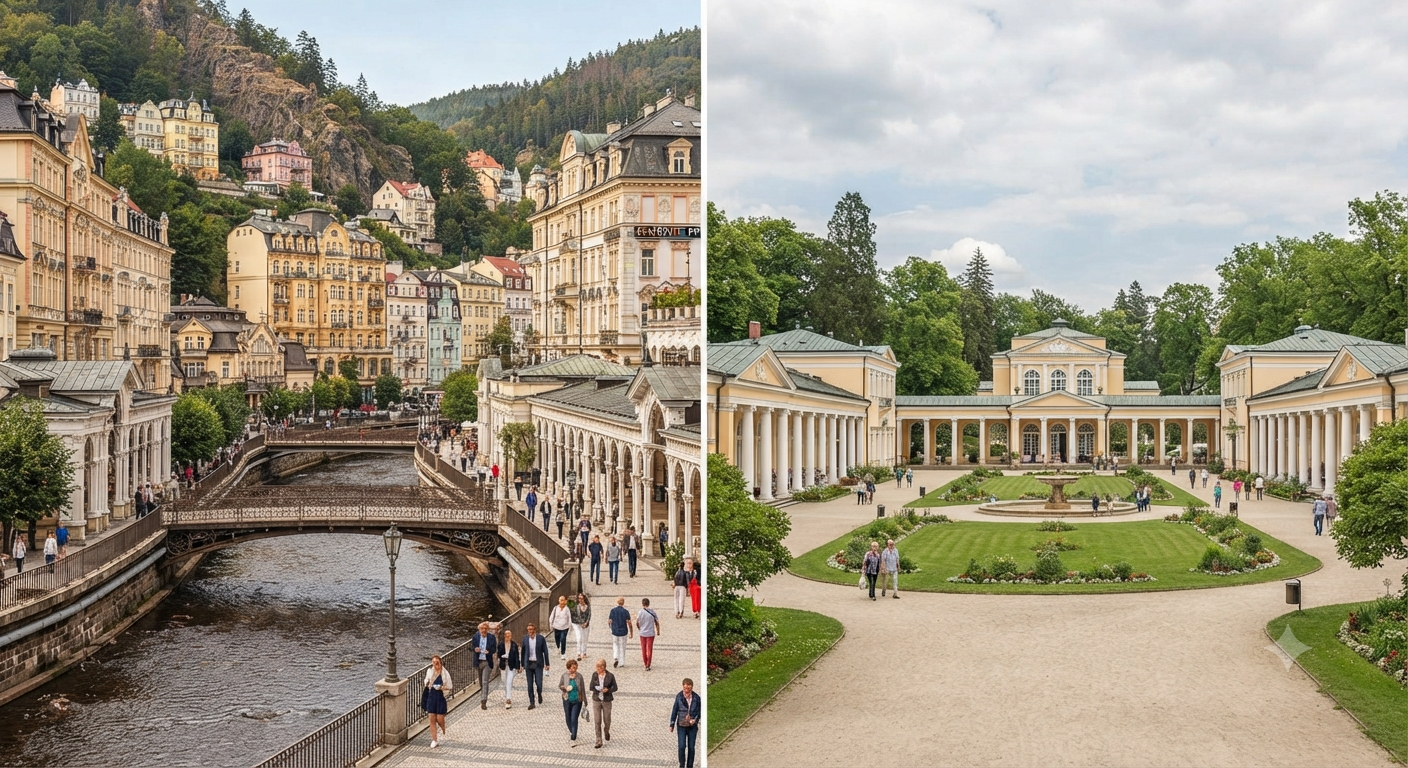
| Atmosphere | Lively, cosmopolitan, city life | Quiet, elegant, expansive parkland |
| Spa Park | Smaller colonnades, valley setting | 100 hectares — largest in the Czech Republic |
| Door-to-Door Transfer | ✅ | ✅ |
| Kurdauer | 14–21 days | 14–21 days |
Karlovy Vary in Detail
Karlovy Vary — founded 1370 by Emperor Charles IV — is the largest and most traditional Czech spa. Its 13 hyperthermal springs at 30–73 °C produce sodium-bicarbonate-sulphate water with 6.8 g/l total mineralisation. The water is drunk hot — the temperature relaxes the smooth muscles of the stomach, gall bladder and bile ducts. This antispasmodic effect is unique: the same water drunk cold does not produce it.
The spa doctor prescribes individually: which of the 13 springs, how much — 3 ml per kg body weight — and at what time of day. The morning drinking cure at the Mill Colonnade, the midday round at the Market Colonnade, the afternoon sip at the Hot Spring. The drinking cure is complemented by CO₂ baths, the Karlovy Vary speciality Parafango — a combination of moor and paraffin wax — and classical massage. Over 50 spa hotels from three to five stars, including the legendary Grandhotel Pupp operating since 1701, provide accommodation.
Karlovy Vary is lively and cosmopolitan. The narrow valley setting at 370–520 metres creates a mild, protected microclimate. The Mill Colonnade — 132 metres long with 124 Corinthian columns and five springs under one roof — is the architectural heart of the spa. The International Film Festival each July attracts tens of thousands of visitors. For guests who want effective spa treatment combined with culture, cafés and city life, Karlovy Vary is the right choice.
Mariánské Lázně in Detail
Mariánské Lázně — founded 1818 by the Teplá Monastery — is the youngest and most elegant of the Triangle spas. Its 40 cold mineral springs at 7–10 °C have a CO₂ content of up to 2,500 mg/l — the highest of any Czech spa. The water is drunk cold to keep the dissolved CO₂ bound. Upon reaching the stomach, the CO₂ releases, stimulating gastric secretion and acting as a powerful diuretic — the kidneys are flushed intensively, blood pressure drops measurably.
The spa doctor creates an individual drinking plan: which spring, how much, at what time. The drinking cure is complemented by CO₂ baths — particularly intensive due to the natural CO₂ content —, forest moor packs from the surrounding Slavkov Forest, and inhalation with the Forest Spring water. Mariánské Lázně has a modern inhalatorium — one of the largest in Czech spa medicine. Over 20 spa hotels, the 100-hectare spa park — the largest in the country — and a cooler, crisper climate at 630 metres define the resort.
Mariánské Lázně is quiet and elegant. Goethe’s final stay here in 1823 inspired the “Marienbad Elegy”. Chopin performed in 1836. King Edward VII of England was a regular patron. The cast-iron Main Colonnade from 1889 and the Singing Fountain — performing Chopin and Mozart every odd hour — are the symbols of the town. For guests who want effective treatment in an atmosphere of calm, parkland and refinement, Mariánské Lázně is the better choice.
Treatments Compared
| Treatment | Karlovy Vary | Mariánské Lázně |
|---|---|---|
| Drinking Cure | Hot, 3 ml/kg, morning on empty stomach, antispasmodic | Cold, 3 ml/kg, before meals, diuretic |
| CO₂ Bath | Available, CO₂ 350–1,600 mg/l | Particularly intensive — CO₂ up to 2,500 mg/l |
| Moor Pack | Moor + Parafango (Karlovy Vary speciality) | Forest moor, 38–42 °C, from surrounding forests |
| Inhalation | Passive on colonnades (CO₂ + steam) | Active with Forest Spring, modern inhalatorium |
| Massage | Classical, reflex zone, sports massage | Classical, underwater massage, lymphatic drainage |
Which Conditions Are Treated Where?
| Condition | Karlovy Vary | Mariánské Lázně | Recommendation |
|---|---|---|---|
| Chronic Gastritis | ★★★ Hot water neutralises stomach acid | ★ Cold water stimulates mucosa | Karlovy Vary |
| Diabetes Type 2 | ★★★ Improves insulin action, lowers blood glucose | ★ CO₂ promotes circulation | Karlovy Vary |
| Gout | ★★★ Reduces uric acid by up to 30 % | ★ Promotes uric acid excretion | Karlovy Vary |
| Kidney Stones | ★ Sulfate ions flush kidneys | ★★★ CO₂ increases diuresis, regulates pH | Mariánské Lázně |
| Chronic Bronchitis | — No dedicated inhalation | ★★★ Forest Spring inhalation, CO₂-rich air | Mariánské Lázně |
| Hypertension | ★ Warm baths possible | ★★★ CO₂ bath lowers blood pressure without heat | Mariánské Lázně |
| Fatty Liver | ★★★ Thermal water improves liver function | ★ Drinking cure supports | Karlovy Vary |
| Osteoporosis | ★ Drinking cure + exercise | ★★★ Calcium from CO₂ springs, 100 ha park | Mariánské Lázně |
Combining Both Spas
One of the greatest advantages of the West Bohemian Triangle is the proximity of its spas. Karlovy Vary and Mariánské Lázně are only 40 kilometres apart — 35 minutes by transfer. Many guests use this closeness for a combination cure: one week Karlovy Vary for digestion, diabetes and metabolism, followed by one week Mariánské Lázně for kidneys, urinary tract and blood pressure. The spa doctors of both resorts coordinate treatment plans. Your luggage travels in the transfer vehicle — you check out in the morning and are checked into the next spa hotel by midday.
Getting to Both Spas from Germany
Both resorts lie in the West Bohemian Triangle, just across the German border. Karlovy Vary is 170 kilometres from Dresden (2 hours 15 minutes), 180 kilometres from Nuremberg (2 hours). Mariánské Lázně is 150 kilometres from Nuremberg (1 hour 45 minutes). The door-to-door transfer with German-speaking driver collects you from your home address. For a combination stay, the transfer between the two resorts takes 35 minutes. Karlovy Vary International Airport lies between them — 10 kilometres from Karlovy Vary, 40 kilometres from Mariánské Lázně.
Frequently Asked Questions
Can I visit both spas in a single cure?
Yes — the 40 kilometres between Karlovy Vary and Mariánské Lázně are covered in 35 minutes by transfer. Many guests book a combination cure with one week per resort. The spa doctors coordinate the treatment plans. Your luggage travels with you — you check out in the morning and are in the next spa hotel by midday.
Which spa is better for older guests?
Mariánské Lázně is flatter and easier to explore on foot — the colonnades and spa park are level and expansive, with no inclines. Karlovy Vary lies in a narrow valley with some gradients but has more lifts and shorter distances between springs. Both are suitable for older guests — the choice depends on mobility and the diagnosis.
Is Karlovy Vary really more expensive than Mariánské Lázně?
Karlovy Vary, with 50+ spa hotels, has a wider price range — from affordable three-star to the luxurious Grandhotel Pupp. Mariánské Lázně is generally 10–20 percent less expensive for comparable hotel categories but has less choice in the luxury segment. Both offer packages with full board, drinking cure and medical care.
Which spa has better air quality?
Mariánské Lázně lies at 630 metres in a wide, open valley surrounded by dense forests — the air is particularly clean and oxygen-rich, ideal for respiratory diseases. Karlovy Vary at 370–520 metres in a narrow valley has a milder, more protected microclimate — warmer and more sheltered. Compare Czech spas — see all comparisons.
Note: This information is for general guidance only and does not replace individual medical advice or diagnosis by a physician.

Author: Kuropa Editorial Team
Expert review: Anastasia Folak, Head of Spa Advisory
15+ years of experience in spa travel consulting
More about our expertise →