
🛡️ No Prepayment
Pay only on arrival
🚗 Door-to-Door Transfer
Directly to the hotel
🏥 Expert Care
English-speaking support
Germany vs Czech Republic — At a Glance
| Feature | Germany | Czech Republic |
|---|---|---|
| Spas in Network | — (German spas are primarily domestic, insurance-based) | 8 resorts (Karlovy Vary, Mariánské Lázně, Františkovy Lázně, Teplice, Jáchymov, Poděbrady, Konstantinovy Lázně, Luhačovice) |
| Healing Factors | Thermal water, moor, brine, climate — standardised and regulated | 200+ mineral springs, CO₂, sulfur mud, Glauber salt, radon, Vincentka iodine water |
| Specialisation | Broad, less depth in individual indications | World-leading depth — digestion ★★★, kidneys ★★★, gynaecology ★★★, rheumatology ★★★, cardiovascular ★★★, respiratory ★★★ |
| Insurance | Statutory health insurance frequently covers spa cures (Kur) with doctor’s prescription | Self-pay or private insurance — significantly lower cost than German spas |
| Atmosphere | Clinical, structured, protocol-driven | Historic, culturally rich, traditional spa culture |
| Accessibility | Domestic — no travel required for German residents | Directly on the German border — accessible in 1–3 hours by transfer |
| Costs | Higher — German spa hotel and treatment fees | 30–50 % lower than comparable German spas |
| Kurdauer | 3 weeks (standard German Kur) | 7–21 days — flexible |
The Czech Republic in Detail
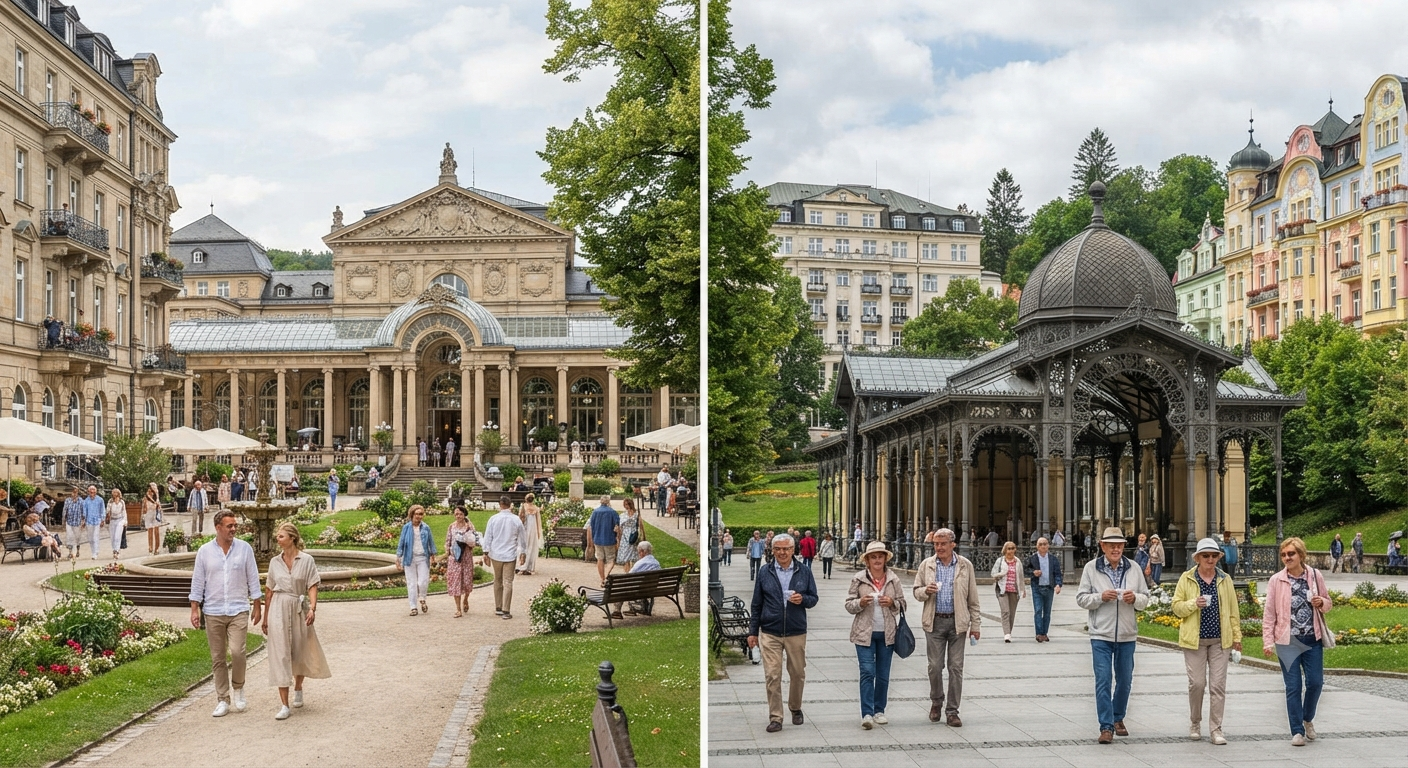
The Czech spa tradition is the oldest continuous medical bathing culture in continental Europe. Karlovy Vary was founded in 1370, Mariánské Lázně in 1818, and Františkovy Lázně in 1793. Three Czech spas are inscribed as UNESCO Great Spas of Europe — a recognition of their unique contribution to world spa culture.
The Czech approach is specialised and intensive. Each resort focuses on one or two disease groups with a depth that no German spa can replicate. Karlovy Vary treats digestion, diabetes and gout with hot mineral water at up to 73 °C — the heat itself is the therapeutic agent. Mariánské Lázně treats kidneys and hypertension with CO₂-rich cold water that acts as a natural diuretic. Františkovy Lázně treats gynaecology and infertility with Glauber-salt water at 23 g/l and iron-rich moor. Jáchymov treats rheumatoid arthritis with low-dose radon that activates the body’s anti-inflammatory enzymes for six to twelve months after a single course.
The drinking cure — walking between colonnades with a porcelain cup, sipping from prescribed springs — is a ritual with 650 years of documented clinical observation behind it. The German-speaking care is centuries old: in the Triangle spas, German was the primary language of guests well into the 20th century. The cost of a three-week cure in a Czech spa is typically 30–50 percent lower than in a comparable German spa, and no doctor’s prescription is required — you book and arrive.
Germany in Detail
German spas operate within a fundamentally different framework. The German Kur — a three-week medical spa stay — is regulated by the statutory health insurance system. A Kur requires a doctor’s prescription, approval by the insurance fund, and is typically granted once every three to four years for specific chronic conditions. The protocols are standardised: defined numbers of baths, packs, massages and physiotherapy sessions. The atmosphere is clinical and structured — effective, but without the cultural dimension of the Czech spa tradition.
For self-paying guests — those without a prescription or whose condition does not warrant insurance coverage — German spas are significantly more expensive than Czech spas for a comparable medical programme. The infrastructure exists — Bad Kissingen, Bad Nauheim, Bad Füssing are well-equipped German spa towns — but the cost-to-treatment ratio favours the Czech Republic by a large margin for private payers.
The advantage of a German Kur is the insurance coverage. If your condition meets the statutory criteria and your doctor prescribes a Kur, the insurance fund covers the treatment and accommodation. The bureaucratic process — prescription, application, approval — can take weeks or months. The Czech system is the opposite: you book when you want, arrive when you want, and pay yourself.
Treatments Compared
| Aspect | Germany | Czech Republic |
|---|---|---|
| Drinking Cure | Available, but less central to treatment | The defining therapy — 650 years of documented practice |
| CO₂ Bath | Available at designated spas | World-leading intensity — Mariánské Lázně CO₂ at 2,500 mg/l |
| Mud/Moor Therapy | Standardised moor packs | Sulfur mud (Piešťany 67–69 °C), Glauber salt (23 g/l), Parafango (Karlovy Vary speciality) |
| Radon Therapy | Limited availability | Jáchymov — world’s first radon spa, documented six-month effect |
| Respiratory Therapy | Salt grottos, inhalation | Vincentka inhalation (Luhačovice) — unique iodine water |
| Prescription Required | Yes — for insurance coverage, doctor’s prescription mandatory | No — you book and arrive independently |
Which Country for Which Condition?
| Condition | Germany | Czech Republic | Recommendation |
|---|---|---|---|
| Digestion, Diabetes, Gout | Standardised drinking cures | ★★★ World leader — Karlovy Vary with 650 years of specialisation | Czech Republic |
| Kidneys, Urinary Tract | Standardised protocols | ★★★ CO₂-driven diuresis unique to Mariánské Lázně | Czech Republic |
| Rheumatoid Arthritis | Physiotherapy, moor packs | ★★★ Radon therapy documents 6–12 month remission — Jáchymov | Czech Republic |
| Gynaecology, Infertility | Standard gynaecological treatments | ★★★ 230-year documented history — Františkovy Lázně | Czech Republic |
| Post-Heart Attack Rehab | Excellent rehabilitation infrastructure | ★★★ Specialised cardiac spa — Poděbrady with flat terrain and CO₂ | Czech Republic |
| Insurance Coverage | ★★★ Statutory insurance covers Kur with prescription | Self-pay — significantly lower cost than German private rates | Germany (with insurance) |
| Flexibility, No Bureaucracy | Prescription, application, approval required | ★★★ Book and arrive — no forms, no wait | Czech Republic |
Costs and Practical Considerations
A three-week cure in a Czech spa — including full board, accommodation in a three- or four-star spa hotel, daily medical supervision and all prescribed treatments — typically costs 30–50 percent less than a comparable self-paid programme in Germany. No doctor’s prescription is required. You book online or by phone and arrive. Door-to-door transfer from your home in Germany is available to all eight Czech spas.
For German residents whose condition qualifies for statutory insurance coverage, a German Kur eliminates the cost of treatment entirely — the insurance fund covers it. The trade-off is the bureaucratic process and the fixed schedule: the insurance fund, not you, decides when and where.
A Typical Spa Day — Czech Republic vs Germany
| Time | Czech Spa (Karlovy Vary) | German Kur |
|---|---|---|
| 06:30 | Rise — walk to the colonnade | Rise |
| 07:00 | Drinking cure at the spring — porcelain cup | Prescribed treatment — bath or pack |
| 07:30 | Rest on a colonnade bench | Rest period |
| 08:00 | Breakfast | Breakfast |
| 09:00 | CO₂ bath — 20 minutes | Physiotherapy or group exercise |
| 10:00 | Walk on the colonnades — social, cultural | Second prescribed treatment |
| 12:00 | Second drinking cure — before lunch | Rest or free time |
| 12:30 | Lunch | Lunch |
| 14:00 | Moor pack or massage | Prescribed treatment |
| 16:00 | Third drinking cure — afternoon | Free time |
| 17:30 | Dinner | Dinner |
| 19:00 | Colonnade concert, walk, café | Evening walk |
Frequently Asked Questions
Why choose a Czech spa over a German one?
For three reasons: specialisation, cost, and cultural experience. The Czech spas are world leaders in specific disease areas — Karlovy Vary for digestion, Mariánské Lázně for kidneys, Jáchymov for rheumatology — with a depth of documented clinical tradition that German spas cannot match. The cost is 30–50 percent lower for self-paying guests. And the experience — walking between colonnades with a porcelain cup, steeped in 650 years of tradition — has no German equivalent.
Do I need a doctor’s prescription for a Czech spa?
No — you book and arrive. A spa doctor conducts an initial examination upon arrival and prescribes treatments individually. If you have a prescription or medical documentation from your home doctor, bring it — it helps the spa doctor tailor the treatment plan.
Can my German health insurance cover a Czech spa?
Generally no — Czech spas are not part of the German statutory health insurance system. Private international health insurance policies sometimes cover foreign spa treatment — check your policy. The cost of a three-week Czech spa cure is often comparable to or lower than the co-payment required for a German Kur.
Which Czech spa is best for a first-time visitor?
Karlovy Vary is the most accessible — the largest, the most cosmopolitan, the easiest to navigate. Mariánské Lázně is quieter and more elegant. Františkovy Lázně is the most intimate. The choice should ultimately be determined by your diagnosis — come for the treatment, and the atmosphere will follow. Compare all spas — see all comparisons.
Note: This information is for general guidance only and does not replace individual medical advice or diagnosis by a physician.

Author: Kuropa Editorial Team
Expert review: Anastasia Folak, Head of Spa Advisory
15+ years of experience in spa travel consulting
More about our expertise →