
🛡️ No Prepayment
Pay only on arrival
🚗 Door-to-Door Transfer
Directly to the hotel
🏥 Expert Care
English-speaking support
Key Facts
• Oldest spa treatment — thermal baths have been used therapeutically for over 2,000 years since Roman times
• 8 spa resorts in 6 countries — Karlovy Vary ★★★, Hévíz ★★★, Piešťany ★★★, Abano Terme ★★★, Budapest ★★, Rimske Terme ★★, Varna ★★, Druskininkai ★★
• Three mechanisms simultaneously — heat (muscle relaxation + vasodilation), minerals (transdermal absorption), buoyancy (joint unloading)
• Water temperature 30–87 °C — the hotter the water, the stronger the muscle relaxation and circulation boost
• Underwater traction — invented in Hévíz in 1953: the spine is stretched in 38 °C water by body weight, pain-free
• German-speaking medical care at all recommended spa resorts
• No prepayment — pay at the hotel on arrival
Thermal Bath at a Glance
| Feature | Details |
|---|---|
| Definition | Bathing in natural, mineral-rich thermal water for therapeutic purposes |
| Water Temperature | 30–87 °C depending on the spring |
| Key Spas | 8: Karlovy Vary, Hévíz, Piešťany, Abano Terme, Budapest, Rimske Terme, Varna, Druskininkai |
| Effect | Muscle relaxation, vasodilation, joint unloading, transdermal mineral absorption |
| Duration per Bath | 15–20 minutes |
| Frequency | Once daily or every second day, as prescribed |
| Kurdauer | 14–21 days recommended |
What Is a Thermal Bath?
A thermal bath is the immersion in natural, mineralised spring water that emerges from the earth at a temperature of at least 20 °C. Unlike an ordinary bath in tap water, a thermal bath acts on the body on three levels simultaneously — physically through the water temperature, chemically through the dissolved minerals, and mechanically through the hydrostatic water pressure.
The physical effect is the most immediate: the warm to hot water relaxes the skeletal muscles, dilates blood vessels, and increases circulation by up to 40 percent. Painful muscle tension releases, joint mobility improves measurably. Simultaneously, the hydrostatic water pressure reduces the load on the joints — in water, the body weighs only about one-tenth of its normal weight, which is critical for patients with arthrosis or after joint surgery.
The chemical effect unfolds through the skin: the minerals dissolved in the thermal water penetrate through the pores into the upper skin layers and are absorbed into the bloodstream. Sodium ions have a pain-relieving effect on nerve endings; sulfate ions promote detoxification via the liver and kidneys; bicarbonate buffers excess tissue acids. In Karlovy Vary, with a total mineralisation of nearly seven grams per litre, this effect is particularly pronounced — after 20 minutes in the thermal bath, the body has absorbed a measurable amount of minerals.
thermal baths differ fundamentally according to their water composition:
Sodium-bicarbonate-sulfate thermal baths in Karlovy Vary and Piešťany have a strong anti-inflammatory and pain-relieving effect — ideal for arthrosis and rheumatism. Radon thermal baths in Jáchymov use the ionising radiation of dissolved radon, which activates the body’s own anti-inflammatory enzymes. Sulfur thermal baths in Abano Terme and Hévíz accelerate the regeneration of cartilage tissue and improve joint lubrication. CO₂ thermal baths in mariánské lázně and Budapest dilate the skin capillaries and lower blood pressure — particularly effective for cardiovascular disease.
Which Spas Offer Thermal Baths?
| Spa | Country | Thermal Water | Temperature | ★ |
|---|---|---|---|---|
| Karlovy Vary | Czech Republic | 13 springs, Na-HCO₃-SO₄, 6.8 g/l, CO₂ 350–1,600 mg/l | 30–73 °C | ★★★ |
| Hévíz | Hungary | Natural thermal lake, sulfur, calcium, magnesium | 38 °C summer, 23 °C winter | ★★★ |
| Piešťany | Slovakia | Sulfur thermal water from 2,000 m depth | 67–69 °C (cooled to 38 °C) | ★★★ |
| Abano Terme | Italy | Hyperthermal springs, radon, iodine, bromine, sulfides | up to 87 °C | ★★★ |
| Budapest | Hungary | 130+ springs, 1.8 g/l, CO₂ 375 mg/l | 22–77 °C | ★★ |
| Rimske Terme | Slovenia | Roman thermal springs, Ca-Mg-HCO₃ | 38–42 °C | ★★ |
| Varna | Bulgaria | 12 springs, hydrocarbonate, 592 mg/l | 38–46 °C | ★★ |
| Druskininkai | Lithuania | 8 springs, up to 52.5 g/l (Surutis, diluted) | 37–40 °C | ★★ |
Who Can Benefit from a Thermal Bath?
| Condition | Recommended Spa | Mechanism |
|---|---|---|
| Arthrosis | Hévíz, Piešťany | Water pressure unloads joints, sulfur regenerates cartilage, underwater traction stretches the spine |
| Rheumatoid Arthritis | Piešťany, Karlovy Vary | Heat and sulfur reduce inflammatory flares, improve mobility |
| Bechterew’s Disease | Hévíz, Piešťany | Underwater traction corrects spinal curvature, improves breathing |
| Herniated Disc | Hévíz | Underwater traction decompresses discs, repositions small prolapses |
| Chronic Back Pain | Karlovy Vary, Budapest | Heat relaxes deep back muscles, minerals relieve pain |
| Cardiovascular Disease | Budapest, Rimske Terme | CO₂ baths dilate capillaries, lower blood pressure, improve circulation |
| Psoriasis, Neurodermitis | Abano Terme, Varna | Sulfur and iodine-bromine calm the skin, thermal water gently peels |
| Gout | Karlovy Vary, Hévíz | Sulfate ions promote uric acid excretion, heat dissolves crystals in joints |
Not suitable for: acute infections, decompensated heart failure, acute deep vein thrombosis, open wounds, and acute inflammatory phases of rheumatoid arthritis. The spa doctor determines individual suitability during the initial examination.
How a Thermal Bath Works Step by Step
Before the first bath, a thorough examination by the spa doctor is conducted. Bring your current medical reports, a medication list, and a description of your joint complaints — the doctor decides which thermal water you bathe in, at what temperature, and for how long.
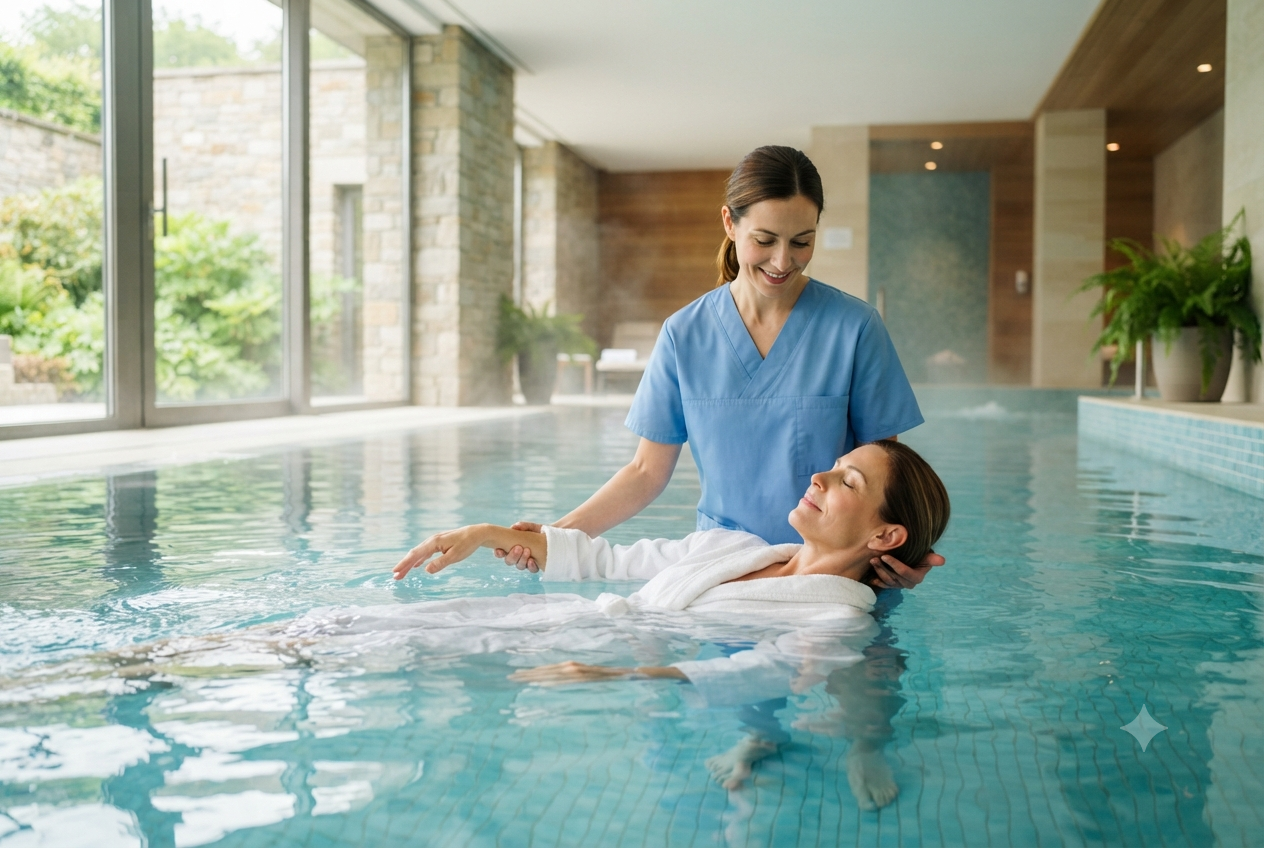
The thermal bath typically lasts 15–20 minutes. Longer bathing overtaxes the circulation and can lead to dizziness, blood pressure drop and exhaustion. After the bath, a 30-minute rest period follows: the body is warm and well-circulated, the metabolism is working at full capacity. Movement immediately after the bath can weaken the therapeutic effect — many spa hotels have dedicated rest rooms with loungers directly next to the thermal pools.
A special procedure is underwater traction, invented in 1953 in Hévíz, Hungary, and now used worldwide in orthopaedic spa clinics. The patient is fixed vertically in a 38 °C thermal pool. Body weight and additional weights gently stretch the spine — the intervertebral discs are decompressed, nerve endings are freed, and small disc prolapses are repositioned. The warmth of the water relaxes the deep back muscles, making this passive stretching possible without pain. The procedure is performed three times weekly for 20 minutes each. Physiotherapy — learn more about underwater traction.
What to bring: swimwear — many spa hotels provide bathrobes and towels. A water bottle for before and after the bath — fluid loss through the warm water is significant. For cardiovascular patients: a medical certificate confirming fitness for bathing.
A Typical Spa Day with a Thermal Bath
| Time | Activity |
|---|---|
| 07:00 | Rise — a glass of still water |
| 07:30 | Breakfast |
| 08:30 | Medical check — pulse and blood pressure measurement |
| 09:30 | Thermal bath — 15–20 minutes at the prescribed temperature |
| 10:00 | Rest period — 30 minutes on a lounger |
| 10:30 | Physiotherapy or therapeutic exercise |
| 12:00 | Lunch |
| 13:30 | Short walk in the spa park |
| 15:00 | Massage — classical, lymphatic drainage or reflex zone |
| 16:00 | Drinking cure or inhalation — as prescribed |
| 17:30 | Dinner |
| 19:00 | Evening walk — 30–45 minutes |
Frequently Asked Questions
How is a thermal bath different from a warm bath at home?
The crucial difference is the minerals dissolved in the water, which are absorbed through the skin — tap water does not contain these in therapeutic concentrations. Thermal water also comes from depths of several hundred to two thousand metres and is free of surface contaminants and chlorine. The thermal bath is monitored daily by a spa doctor who individually adjusts the temperature and duration.
Is a hotter thermal bath always better?
No — the temperature is strictly determined by the diagnosis. 38 °C relaxes and is ideal for the musculoskeletal system. 42 °C and above stimulates the immune system but places greater demands on the circulation. The spa doctor typically begins with lower temperatures and increases gradually. For cardiovascular patients, mild CO₂ baths at 34 °C are the treatment of choice.
Can I combine thermal baths with moor packs?
Yes — the combination of thermal bath and moor pack has been a proven standard programme for decades, particularly in Abano Terme and Hévíz. The thermal bath prepares the muscles and opens the pores; the subsequent moor pack with its organic acids and trace elements then acts more intensively. Moor pack treatment — learn more. The spa doctor plans the sequence so that the circulation is not overloaded — typically thermal bath in the morning, moor pack in the afternoon or on alternating days.
Are thermal baths also available for children?
Some spa resorts offer special thermal pools for children — particularly in Hungary and Slovakia. The temperatures are lower, bathing times are shorter, and supervision is child-appropriate. The treatment of childhood rheumatism or postural disorders in thermal water shows excellent results.
How many thermal baths per week are optimal?
Spa doctors recommend three to four thermal baths per week — the body needs time to regenerate between baths. For arthrosis pain, the doctor may prescribe daily baths in the first week of the course, then reduce the frequency in subsequent weeks.
Note: This information is for general guidance only and does not replace individual medical advice or diagnosis by a physician.

Author: Kuropa Editorial Team
Expert review: Anastasia Folak, Head of Spa Advisory
15+ years of experience in spa travel consulting
More about our expertise →